



Author: Mohamed Sharfiras
Can you use the same conveyancer as the seller?
If you’re buying a property, it’s natural to wonder whether you can use the same conveyancer as the seller to save time and keep things simple. In most cases, the honest answer is no, because conveyancing solicitors have to follow strict conflict of interest rules.
That doesn’t mean the question isn’t worth asking. There are a small number of situations where a firm might still be able to act, and understanding why the rules exist will help you see why having your own independent solicitor is usually the safer choice.
This guide covers what the rules actually say, when a same solicitor for buyer and seller arrangement is ever considered, whether your mortgage lender has a view, and what to do if your chosen firm has to say no.
The quick answer: can you use the same conveyancer as the seller?
Conveyancing solicitors are bound by their regulator’s Code of Conduct, which says a solicitor must not act where there’s a conflict, or a significant risk of a conflict, between the interests of two or more clients. In a typical house purchase, the buyer and the seller don’t share the same interests. One wants the highest price and the earliest possible completion, the other wants the lowest price and more flexibility, so a conveyancing conflict of interest exists from the outset.
Solicitors are sometimes allowed to act for clients with conflicting interests if those clients share a substantially common interest in the matter. However, this exception generally doesn’t apply to an ordinary property purchase, because although both sides want the sale to complete, they don’t share the same interest in price, timing, or the condition of the property. This is why using the same conveyancer as the seller is unusual rather than routine, and why most solicitors will decline before the question is even fully asked.
What is a conveyancing conflict of interest, exactly?
There are two types of conflict a solicitor has to watch for, and understanding them explains why firms are so cautious about acting for both sides of a sale.
- Client conflict: when the solicitor’s duty to act in the best interests of one client would work against the interests of another client, such as disagreeing on price or completion dates
- Own interest conflict: when the solicitor’s personal or financial interest in the outcome could affect the advice they give to a client
A conveyancing conflict of interest doesn’t need to be an active argument to matter. Even the possibility that advice given to one side could disadvantage the other is enough for a solicitor to decline, or to withdraw if it emerges partway through a transaction.
- Disputes over the survey findings or who pays for remedial work
- Disagreements about what’s included in the sale, such as fixtures and fittings
- One party wanting to renegotiate the price after exchange of contracts
- A breakdown in the chain that affects one side more than the other

When might a same solicitor for buyer and seller arrangement be considered?
There are narrow circumstances where a firm may agree to act for both parties, though it remains uncommon in practice. These tend to involve family transactions or connected parties where there’s genuinely little room for disagreement.
- Both parties give fully informed, written consent to the arrangement
- There’s no realistic scope for a dispute over price, timing, or conditions
- Each party is represented by a different, separate solicitor within the same firm
- Strict confidentiality safeguards are put in place between the two files
- The firm carries out conflict checks throughout the transaction, not just at the start
Why most firms will still say no
Even where the criteria above look like they could be met, many firms decline to act for both sides. The regulatory risk to the firm is significant if a dispute later emerges, and a solicitor who has to withdraw partway through a transaction can cause more delay and cost than if two separate firms had been instructed from day one.
Does your mortgage lender allow a same solicitor for buyer and seller setup?
Even if a firm is willing to consider acting for both of you, your mortgage lender has its own say in the matter. Most lenders require the solicitor handling their security to be on their approved conveyancing panel, and many lender instructions specifically restrict solicitors from acting for a borrower where a conveyancing conflict of interest with the seller could arise.
- If you’re buying with a mortgage, ask early whether your lender’s panel terms allow shared representation
- Cash purchases have more flexibility, though the conflict of interest rules still apply between the two clients
- Related-party sales, such as buying from a family member, often face extra scrutiny from both the lender and the solicitor
What happens if your solicitor can’t act for both of you?
If a firm decides it can’t take on a same conveyancer as the seller arrangement, the process is simple. The buyer instructs their own independent solicitor, and the transaction continues as normal, just with two firms working towards the same completion date rather than one.
At Versus Law, our residential conveyancing team acts independently for buyers and sellers, giving each client a dedicated point of contact who can give full, unconflicted advice throughout the transaction.
Wondering if you need your own conveyancing solicitor?
If you’ve been offered the option of using your seller’s solicitor, it’s worth getting independent advice before you agree. Get in touch with our conveyancing team and we’ll explain what independent representation would mean for your purchase.
The perceived benefits, and the real risks, of a same solicitor for buyer and seller arrangement
It’s easy to see why buyers and sellers are drawn to the idea. In theory, using the same solicitor for buyer and seller could mean:
- Fewer parties to coordinate, which can feel simpler
- One set of systems and timetables instead of two
- Less back and forth between separate firms
But the risks tend to outweigh these perceived benefits in practice:
- If a conflict does emerge, the solicitor may have to stop acting for one or both parties partway through
- Neither party gets fully independent advice on the terms of the sale
- Regulatory complications can cause more delay than using two firms from the start
- One party may unintentionally be at a disadvantage if the solicitor can’t advise as freely as they would with a single client
Is it a bad idea to use the same solicitor as the seller?
It isn’t necessarily a bad idea in every case, but it’s rarely the safer one. Even where a firm agrees to act for both sides with separate individual solicitors and full safeguards in place, you’re still relying on the same organisation to manage two sets of confidential information and two potentially different sets of priorities. Most buyers find that the small amount of time saved isn’t worth giving up fully independent advice.
Getting independent advice as a buyer
Choosing your own solicitor, rather than using the same conveyancer as the seller, means you get advice that’s focused entirely on your interests, from the survey stage through to completion. The Law Society’s own guidance on conflict of interest in conveyancing confirms that the common interest exception generally doesn’t apply to a standard buyer and seller relationship, which is why most firms will only ever act for one side of a transaction.
At Versus Law, we offer fixed-fee residential conveyancing with a dedicated solicitor who works for you alone, so there’s never any question about whose interests come first.
Ready to instruct your own conveyancing solicitor?
Whether you’ve been asked to use your seller’s solicitor or you’re simply looking for independent advice, our Manchester team is ready to help. We’ll give you a clear, fixed-fee quote and a dedicated solicitor who acts for you and nobody else, with no conveyancing conflict of interest to worry about.
-
Additional conveyancing fees you might not expect to pay
-
What is a TA13 form? Completion information and requisitions on title explained

-
What is a TA7 leasehold information form?

-
What is a TA6 property information form?
-
What is a TA10 form?

-
What is checked during conveyancing? A complete guide

-
What salary do you need for a £300k house in the UK?

-
What is the hardest month to sell a house in the UK?

-
Who can sponsor a visa in the UK?

-
How long does a flight have to be delayed for compensation?

OTHER NEWS
Additional conveyancing fees you might not expect to pay
When you’re budgeting for moving home, most people focus on the price of the property, stamp duty, and their solicitor’s headline conveyancing quote. But additional conveyancing fees can catch buyers and sellers off guard if nobody explains them upfront.
A fixed-fee quote covers the standard legal work involved in a straightforward sale or purchase. If your solicitor knows from the outset that your transaction involves something more complex, such as a leasehold property, mortgage, gifted deposit, or new build, the relevant additional work may already be shown in your quote. If an issue only becomes apparent later, an additional fee may need to be added.
Understanding these potential hidden conveyancing costs before you instruct a solicitor can help you budget properly and avoid surprises near completion.
This guide explains where additional conveyancing fees typically come from, the circumstances in which they may apply, what conveyancing disbursements actually cover, and how to keep your final bill as close as possible to the quote you received.
What counts as an additional conveyancing fee?
An additional conveyancing fee is a charge for legal or administrative work that falls outside the work covered by the standard conveyancing fee. Depending on what is known when you request your quote, it may be included from the outset or added later if the additional work only becomes necessary as the transaction progresses.
Common circumstances that can require extra work include:
- Buying or selling a leasehold, share of freehold, or managed freehold property
- Using a gifted deposit from family or friends
- Buying with a mortgage
- Buying a new-build property
- Dealing with multiple registered titles
- Dealing with a restriction, caution, or defect on the title
- Corresponding with third-party lawyers, such as in a divorce or probate matter
- Arranging bridging finance or dealing with an auction purchase
These situations usually involve additional checks, documents, correspondence, reporting, or registration work that would not be required on a straightforward transaction.
For a full breakdown of the charges that may apply, see our additional legal fees and charges.
Common additional fees during a standard purchase or sale
Even a relatively straightforward transaction can require extra work depending on the property, the source of the purchase funds, and the way the property is financed.
Some of the additional services that may be required include:
- Additional bank transfers: where extra payments need to be made, such as dividing sale proceeds between several owners or arranging an additional same-day transfer.
- Additional enquiries arising from a survey: where the purchaser requires advice on further enquiries raised as a result of their survey report.
- Gifted deposit administration: covering the additional source-of-funds work associated with a gifted deposit and reporting to the mortgage lender where necessary.
- Mortgage work: where additional legal work is required for both the client and lender when a mortgage is secured against the property.
- Multiple title reviews: where the property involves more than one registered title, such as a separate garage, stable, parcel of land, or another title affecting the property.
- Indemnity policy administration: for obtaining quotations, reviewing the appropriate policy, and arranging cover where an indemnity policy is required.
- Additional identity checks: where the usual digital verification process cannot be used and further identity or anti-money laundering checks are required.
Not every transaction will attract these fees. The exact charges depend on the circumstances of your sale or purchase, so it is important to disclose anything unusual when requesting your quote.
You can view our current additional conveyancing fees for the latest pricing.
Bank transfers and third-party correspondence fees
Some transactions require extra correspondence outside the usual buyer-and-seller conveyancing process.
This may include corresponding with a third-party lawyer or complying with a court order, such as during a divorce or probate matter.
Additional work may also be required where Versus Law is not acting for the mortgage lender and must liaise with the lender’s separate solicitors and comply with their requirements.
These charges reflect the extra legal and administrative work involved beyond the standard correspondence already covered by the conveyancing transaction.
Extra costs for leasehold and complex leasehold properties
Leasehold transactions usually involve more legal work than a straightforward freehold sale or purchase because there are additional documents to review and third parties such as landlords, freeholders, and managing agents may need to be involved.
Versus Law may charge an additional legal fee for leasehold, share of freehold, or freehold properties with a managing agent. If you tell us about the property type when requesting your quote, any applicable additional work can be identified from the outset.
Other work can sometimes be required as the transaction progresses, including:
- Liaising with an additional managing agent
- Reviewing an additional lease
- Drafting a Deed of Covenant
- Drafting a Deed of Variation
- Reviewing or negotiating a lease extension
There may also be fees payable directly to a landlord, freeholder, or managing agent. These are separate from Versus Law’s legal fee and will depend on the individual property and management arrangements.
A share of freehold or a freehold property with a managing agent can therefore still involve additional conveyancing work, even though there may not be a conventional residential lease to review.
For the latest charges relating to leasehold and managed properties, see our additional fees page.
Additional fees for auction, bridging finance, and new-build purchases
Certain types of property purchase require considerably more work than a standard transaction and can therefore attract higher additional conveyancing fees.
These can include:
- Auction purchases: where additional work is required to review auction documentation and complete within shorter timescales.
- Bridging finance: where additional legal work is required in connection with short-term lending and lender requirements.
- New-build purchases: where extra work may include reviewing estate and plot plans, utility connections, accessways, planning permissions, road development agreements, indemnity requirements, and developer documentation.
- Buy-to-let purchases: where additional checks may be required depending on how the property is being purchased and whether vacant possession is required.
These are particularly important costs to identify before committing to an auction property, bridging loan, or new-build reservation, as the additional legal work forms part of the overall cost of completing the transaction.
A new-build property can look straightforward because nobody has lived in it before, but from a conveyancing perspective there is often considerably more documentation for your solicitor to review.
Full details of the charges that may apply are available on our additional conveyancing fees page.
Other circumstances that can increase your conveyancing fees
Some additional charges only apply in particular situations but can still make a significant difference to the legal work required.
Examples include:
- High-rise properties: where additional work may be required to deal with requirements under the Building Safety Act.
- Overseas or non-UK resident clients: where additional identity, source-of-funds, notarisation, or legalisation work may be required.
- Restrictions or cautions on the title: where extra legal work is needed to identify and resolve issues affecting the registered title.
- Concessionary purchases: where a property is sold to a related party at a discount and additional checks, lender reporting, or insolvency considerations arise.
- Help to Buy ISA or Lifetime ISA administration: where additional administration is required in connection with eligibility and obtaining the relevant government bonus.
Again, these charges only apply where the relevant circumstances exist. Giving your conveyancer full details as early as possible helps them identify which fees are likely to apply before significant work begins.
You can check our full list of additional fees for current pricing and further information.
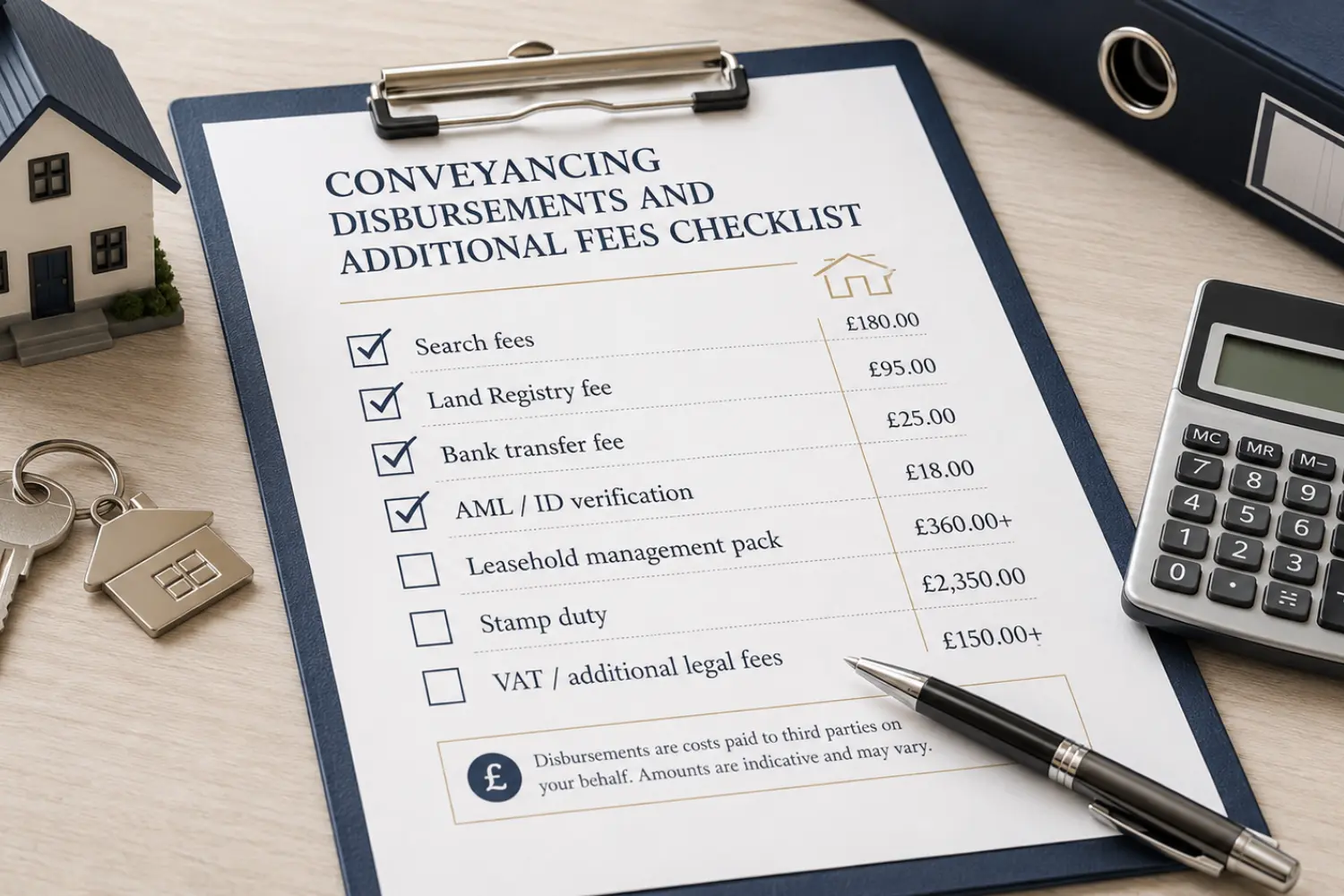
Conveyancing disbursements you’ll need to budget for
Conveyancing disbursements are different from your solicitor’s legal fees.
A legal or administrative fee pays your conveyancer for work carried out on the transaction. A disbursement is generally an amount your solicitor pays to a third party on your behalf as part of completing the transaction.
Common examples can include:
- Local authority searches
- Environmental searches
- Drainage and water searches
- HM Land Registry registration fees
- Fees charged by landlords, freeholders, or managing agents where applicable
- The premium payable for an indemnity insurance policy where one is required
This distinction matters. For example, Versus Law may charge an administration fee for arranging an indemnity policy, while the actual insurance premium is a separate cost payable for the policy itself.
Stamp Duty Land Tax is another significant cost that many buyers need to budget for. It is a tax payable to HMRC rather than a legal fee charged by your conveyancer.
If you’re buying a property, you can check likely Stamp Duty Land Tax costs before committing to the purchase.
Because disbursements and taxes depend on the individual property and transaction, ask for a clear breakdown of your legal fees, additional fees, disbursements, and taxes when reviewing your quote.
Not sure which additional fees apply to your move?
Every transaction is different, and the best way to find out which additional conveyancing fees might apply to yours is to tell us about your circumstances when requesting your quote.
Our Manchester team can explain which charges are relevant and which are not. Get in touch with our conveyancing team and we’ll explain what’s included in your quote.
How to avoid unexpected hidden conveyancing costs
What people sometimes describe as “hidden conveyancing costs” are often additional charges triggered by circumstances that were not apparent when the first quote was prepared.
A little preparation can make it much easier to identify them upfront.
- Ask for a written quote that separates legal fees, additional charges, and disbursements.
- Tell your solicitor upfront if the property is leasehold, share of freehold, managed freehold, or a new build.
- Confirm whether you are buying with a mortgage or using bridging finance.
- Disclose a gifted deposit as early as possible.
- Tell your solicitor if you are buying at auction or working towards an unusually short completion deadline.
- Mention if the property includes multiple registered titles, such as a separate garage or parcel of land.
- Query anything described as an estimate rather than a fixed cost.
- Ask whether any additional fees shown in the firm’s published fee schedule are likely to apply to your circumstances.
- Ask what happens to fees and disbursements if the transaction falls through.
The government’s guidance on Stamp Duty Land Tax is also a useful starting point for understanding how this separate tax may affect your moving budget.

Why choose Versus Law for transparent, fixed-fee conveyancing
At Versus Law, we quote for residential conveyancing on a fixed-fee basis, so you know what the standard legal work covered by your quote will cost.
Where additional work applies, such as dealing with a leasehold property, mortgage, gifted deposit, multiple titles, or new-build purchase, we aim to identify the relevant charges as early as possible.
You can also see our published additional legal fees and charges online, making it easier to understand which additional services may apply to your transaction and check the latest pricing.
Our Manchester-based team is CQS accredited and has handled more than 10,000 property exchanges, giving you a dedicated point of contact who knows your file rather than a call centre, with a clear breakdown of your legal fees and conveyancing costs from the outset.
Whether you’re buying a first flat in the city centre, selling a family home in Chorlton, or dealing with a more complex leasehold transaction, our proactive approach means we chase third parties before delays happen, not after, and keep you updated by phone, email, or WhatsApp throughout.
Ready to get a clear, fixed-fee conveyancing quote?
Understanding additional conveyancing fees before you start is one of the best ways to keep your house move on budget.
Our team will talk you through your quote in plain English, explain which legal fees and conveyancing disbursements apply to your case, and identify any additional work we know will be required.
-
Can you use the same conveyancer as the seller?

-
What is a TA13 form? Completion information and requisitions on title explained
-
What is a TA7 leasehold information form?
-
What is a TA6 property information form?
-
What is a TA10 form?
-
What is checked during conveyancing? A complete guide
-
What salary do you need for a £300k house in the UK?
-
What is the hardest month to sell a house in the UK?
-
Who can sponsor a visa in the UK?
-
How long does a flight have to be delayed for compensation?
OTHER NEWS
What is a TA13 form? Completion information and requisitions on title explained
A TA13 form, officially called Completion Information and Requisitions on Title, is the standard Law Society document that your solicitor uses to lock down the practical details of completion just before a property sale finishes. If you have been told your conveyancer is “waiting on the TA13” or “raising requisitions,” this is the paperwork behind that phrase, and it matters more than its dry name suggests.
What is a TA13 form, in plain English?
Strip away the legal phrasing and a TA13 form is really a checklist. Towards the end of a sale, the buyer’s solicitor sends a standard set of questions, known as requisitions on title, to the seller’s solicitor, using the TA13 form as the template. The seller’s solicitor answers each question and returns the completed form, confirming the details the buyer’s side needs before money changes hands and keys are released.
Almost every residential conveyancing transaction in England and Wales uses this form, or a close variant of it, in the run-up to completion. It is a routine document, but a routine one that carries real legal weight. Most buyers and sellers never see the form itself, since it passes between solicitors rather than clients, but the answers it records shape exactly when and how their move actually happens.
Why the TA13 form matters more than its name suggests
Some of the answers given on a TA13 form are treated in law as a solicitor’s undertaking, not just an informal reply. That distinction matters, since a solicitor’s undertaking is a formal promise their firm is bound to honour, and breaching one is a serious professional matter, not a simple broken promise between neighbours.
That is exactly why completion information and requisitions on title are not treated as a box-ticking exercise by a competent conveyancer. If a seller’s solicitor confirms on a TA13 form that a mortgage will be redeemed on completion, for example, the buyer’s side is entitled to rely on that as a binding commitment, not just a statement of intent. That reliance matters in practice, because it lets the buyer’s solicitor release funds on completion day with confidence, rather than waiting for separate proof that every step has genuinely been taken care of.
What information does a TA13 form actually cover?
A completed TA13 form typically confirms several practical points that need to be settled before completion can safely go ahead:
- Vacant possession, and exactly when the property will be empty and available
- Deeds and documents that will be handed over, or held to order, on completion
- Completion arrangements, including timing and how funds will be sent
- Bank details and the precise amount to be paid on the day
- Confirmation that any existing mortgages or charges will be redeemed
Between them, these sections cover most of the practical risk points in a transaction, which is why a thorough conveyancer reviews the completed TA13 form carefully rather than filing it away unread.
The vacant possession answer is worth reading twice
Of everything on the form, the vacant possession confirmation is one of the most common sources of dispute after completion. If a seller’s solicitor confirms vacant possession but the previous owner has not actually moved out, or has left substantial rubbish or belongings behind, that confirmed answer becomes central to any claim the buyer might bring afterwards.

How the TA13 form fits alongside the other TA forms
The TA13 form is one of a wider family of Law Society Transaction, or TA, forms used throughout a typical sale. Earlier in the process, a TA6 property information form and a TA10 fittings and contents form set out what the buyer is told about the property and what is included in the sale. The TA13 form comes much later, right at the completion stage, and deals with logistics rather than the condition of the property itself.
Understanding where the TA13 form sits in that sequence helps explain why it can only really be finalised close to completion, once a redemption figure for any mortgage is confirmed and a firm completion date has been agreed by everyone in the chain.
Ready to ask about your own completion timeline?
If you are approaching completion and want to understand exactly what your solicitor is waiting on, it helps to talk it through with someone who reviews TA13 forms every week. Our conveyancing team can walk you through where your transaction stands and what is still outstanding before your completion date.
What happens if the TA13 form causes a delay?
A TA13 form is often the last document exchanged before completion, which means any last-minute problem with it tends to land right when everyone is hoping to move quickly. A mortgage redemption figure that has not yet been confirmed, or a seller who has not finished packing, can hold up an otherwise ready transaction at the worst possible moment.
Good conveyancing practice is to chase the information behind the TA13 form early, rather than waiting until completion day to discover a gap. A solicitor who leaves these checks until the last minute is far more likely to see a chain-wide delay than one who chases redemption figures and vacant possession confirmation as soon as a completion date is realistic. In a chain of several properties, one unanswered requisition can hold up everyone else too, since nobody further along the chain can safely release funds until the gap is closed.
TA13 forms and auction purchases
Completion information and requisitions on title matter even more when time is tight, and nothing compresses a timeline like a property bought at auction. Auction contracts typically demand completion within 14 or 28 days of the fall of the hammer, leaving very little room to chase a slow-moving TA13 form if problems only surface at the last minute.
Specialist auction conveyancing builds this kind of document into the timeline from day one, rather than treating it as an afterthought once the pressure is already on.
Need Help With Your Property Completion?
Our experienced conveyancing solicitors can manage the TA13 form, requisitions on title and completion arrangements to help your property transaction reach completion smoothly.
A quick summary of what to expect
Before completion, it is worth knowing roughly what your solicitor is doing with a TA13 form on your file:
- Your solicitor sends or receives the standard requisitions on title using the TA13 form
- The other side’s solicitor answers each section, including vacant possession and mortgage redemption
- Some of those answers count as a solicitor’s undertaking, not just an informal reply
- Your solicitor reviews the completed form before confirming completion can go ahead
- Any gaps or unclear answers get chased before, not after, funds are sent
Our recent guide on what is checked during conveyancing covers the wider process the TA13 form sits within, from the first title check through to the day you get your keys.
Working with a CQS-accredited conveyancer
Because parts of a TA13 form carry the weight of a solicitor’s undertaking, it is worth having it handled by a firm that takes conveyancing standards seriously. The Law Society’s Conveyancing Quality Scheme sets out the standards that accredited firms are expected to meet on documents exactly like this one.
Our residential conveyancing team is CQS accredited, which means completion information and requisitions on title get the same careful attention on every file, not just the straightforward ones. That consistency is what turns a routine form into a genuine safeguard, rather than a document that only gets proper attention when something has already gone wrong.
Buying or selling and want a clear view of your completion?
A TA13 form might look like routine paperwork, but the answers it contains, particularly around vacant possession and mortgage redemption, can make the difference between a smooth completion and a stressful one. Getting it reviewed properly, and chased early, is one of the simplest ways to avoid a last-minute hold-up. Whether you are buying, selling, or both at once, knowing what your solicitor is waiting on removes a lot of the uncertainty from the final stretch of a move.
-
Can you use the same conveyancer as the seller?
-
Additional conveyancing fees you might not expect to pay
-
What is a TA7 leasehold information form?
-
What is a TA6 property information form?
-
What is a TA10 form?
-
What is checked during conveyancing? A complete guide
-
What salary do you need for a £300k house in the UK?
-
What is the hardest month to sell a house in the UK?
-
Who can sponsor a visa in the UK?
-
How long does a flight have to be delayed for compensation?
OTHER NEWS
What is a TA7 leasehold information form?
If you’re selling a leasehold flat or maisonette in England or Wales, you’ll need to complete a TA7 leasehold information form alongside your other sale paperwork.
This guide explains what the TA7 leasehold information form covers, how it fits with your other seller’s forms, and how a conveyancing solicitor can help you get it right.
Why do sellers need a TA7 form?
Leasehold properties come with extra layers that a straightforward freehold sale doesn’t have – service charges, ground rent, a landlord or management company, and rules about what you can and can’t do to the property. The TA7 form is designed to capture all of that for your buyer.
Unlike a freehold sale, a leasehold property transaction can’t rely on the TA6 form alone. Buyers, their solicitors and their mortgage lenders all use the TA7 to understand what they’re taking on before contracts are exchanged.
If your solicitor is using the Law Society’s Conveyancing Protocol, both the TA6 and TA7 form should be sent to you together, along with the TA10 fittings and contents form, so it’s worth being ready to complete all three at once.
How does the TA7 fit with your other seller’s forms?
The TA7 leasehold information form doesn’t replace anything – it sits alongside the TA6 property information form and the TA10 fittings and contents form as part of your contract pack.
If you’re not sure about the difference between owning a leasehold property and a freehold one, our guide on freehold and leasehold titles explains what each means in practice.
A revised TA7 (5th edition) became mandatory for sellers using CQS-accredited solicitors from 30 March 2026, alongside the updated TA6 (6th edition). If your sale was already underway on an earlier version, you can usually continue with it.
What does the TA7 leasehold information form cover?
The TA7 leasehold information form is split into several sections covering the lease, its management, and your history as a leaseholder. The main areas include:
- Property and seller details – the property address, postcode and your details as seller
- The lease – whether it’s a flat, maisonette or house, and if it’s shared ownership
- Contact details – for the landlord, managing agent, freeholder and any right to manage company
- Management – who collects ground rent and insurance, and whether the management company is active
- Maintenance and service charges – what you pay, any disputes, and upcoming major works
- Notices – any notice to sell the freehold, or other formal correspondence you’ve received
- Enfranchisement – whether you’ve applied to buy the freehold or extend your lease
- Consents – permissions the landlord has given for changes to the property
- Alterations – any changes you’ve made to the property and the paperwork behind them
- Complaints – disputes involving you, the landlord, management company or neighbours
- Building safety – cladding, fire safety and any relevant certificates for blocks of flats
- Additional information – anything else the buyer should reasonably know

Not sure what counts as a notice or consent on your TA7 form?
These sections trip up a lot of sellers, especially when paperwork from years ago has gone missing. Speaking to your conveyancing solicitor before you submit the form means you can get in touch with our conveyancing team and check your answers before they’re sent to the buyer.
What is an LPE1 form, and do I need one too?
Alongside your TA7, your freeholder or managing agent will usually need to complete a separate LPE1 form, which answers many of the same questions from their side of the building.
Our guide on what is an LPE1 form explains what it covers and why buyers ask for one before exchanging contracts.
Need Help With Your Leasehold Property Sale?
Our experienced conveyancing solicitors can guide you through the TA7 leasehold information form and manage your leasehold property transaction from start to finish.
What happens if you get the TA7 form wrong?
Buyers and their solicitors rely on your TA7 leasehold information form to decide whether to proceed with the purchase, and at what price.
If you leave out information you should reasonably have known about, or give a misleading answer, your buyer may be able to claim against you after completion if they can show they’ve suffered a loss as a result.
The safest approach is to complete the form as fully as possible, tell your solicitor if anything changes before completion, and never guess an answer you’re not sure about.
Tips for completing your TA7 leasehold information form
A few habits make completing your TA7 form much easier, and reduce the chance of delays once a buyer is found:
- Request your lease, service charge accounts and any Section 20 notices early
- Contact your management company for up-to-date payment demands
- Say “not known” rather than guessing an answer
- Flag ongoing disputes to your conveyancing solicitor before you sign
- Update your answers straight away if anything changes before completion
Common questions about the TA7 leasehold information form
Do I need a TA7 form for a freehold house?
No. The TA7 is only required when you’re selling a leasehold property, such as a flat, maisonette, or a house held on a long lease. Freehold sales use the TA6 and TA10 forms instead.
What if my service charges have changed recently?
You’ll need to disclose this in the maintenance and service charges section of the TA7 form. The government’s guidance on leasehold service charges explains what a landlord can and can’t charge, though your solicitor can advise on your specific lease.
Our own guide to leasehold service charges covers what’s typically included.
Who fills in the ground rent details on the TA7 form?
You do, as the seller, based on your most recent payment demand. If you’re unsure whether you pay ground rent or a chief rent, our guide on chief rent and ground rent explains the difference.
Can I complete a TA7 form without my lease to hand?
It’s much harder. Request a copy from your management company or landlord as early as possible, ideally before you put your leasehold property on the market, so you’re not held up once a buyer is found.
How a conveyancing solicitor can help
A conveyancing solicitor will read through your TA7 form with you, chase your management company for missing paperwork, and make sure nothing is left blank that could hold up your sale.
If leasehold costs are putting you off selling altogether, it’s worth reading our guide on why people avoid leasehold properties first, since many of the concerns it raises are exactly what the TA7 form is designed to disclose fairly.
Our residential conveyancing solicitors handle leasehold and freehold sales across Manchester and the wider North West, with fixed fees and a dedicated point of contact throughout your sale.
Ready to sell your leasehold property with confidence?
Selling a leasehold flat or maisonette involves more paperwork than a straightforward freehold sale, but the right support makes it manageable. From your TA7 leasehold information form through to exchange and completion, our team keeps you informed at every stage.
Get in touch today, or use our online calculator for a fixed conveyancing quote in minutes.
-
Can you use the same conveyancer as the seller?
-
Additional conveyancing fees you might not expect to pay
-
What is a TA13 form? Completion information and requisitions on title explained
-
What is a TA6 property information form?
-
What is a TA10 form?
-
What is checked during conveyancing? A complete guide
-
What salary do you need for a £300k house in the UK?
-
What is the hardest month to sell a house in the UK?
-
Who can sponsor a visa in the UK?
-
How long does a flight have to be delayed for compensation?
OTHER NEWS
What is a TA6 property information form?
If you’re selling a house or flat in England or Wales, you’ll need to complete a TA6 property information form as part of the conveyancing process.
This guide explains what the TA6 property information form covers, what’s changed in the latest edition, and how a conveyancing solicitor can guide you through it.
Why does the TA6 form matter?
The TA6 form gives your buyer the information they need about your property before they commit to buying it. It covers everything from boundaries and disputes to flooding risk and Japanese knotweed.
Completing a TA6 property information form isn’t a strict legal requirement, but skipping it or rushing through it causes real problems further down the line. Buyers, mortgage lenders and other solicitors in the chain all rely on the answers being accurate.
If you give inaccurate or incomplete answers, your buyer could delay the purchase, pull out of the sale entirely, or come back with a compensation claim after you’ve already moved out. A good conveyancing solicitor will talk you through each question so nothing important gets missed.
What’s new in the TA6 (6th edition)?
From 30 March 2026, the TA6 (6th edition) became mandatory for sellers whose solicitor is accredited under the Law Society’s Conveyancing Quality Scheme (CQS). It replaced the older 4th and 5th edition forms, which had been running alongside each other for some time.
The new TA6 form is shorter and more straightforward than its predecessor, with noticeably fewer sections and clearer explanatory notes for sellers to work through. The changes followed an extended period of consultation with conveyancers, buyers and sellers, aimed at cutting down on the errors that used to trip people up on the older versions.
A revised TA7 leasehold information form was launched alongside it, for sellers of leasehold flats and maisonettes to complete in addition to their TA6. You’ll usually also complete a TA10 fittings and contents form, which lists what’s included and excluded from the sale.
If your sale was already underway on an earlier edition before 30 March 2026, you can usually continue with the version you started on. Ask your conveyancing solicitor if you’re unsure which edition applies to your transaction.
What does the TA6 property information form cover?
The TA6 property information form asks you to disclose detailed information across a wide range of topics connected to your property. The main areas sellers need to cover include:
- Boundaries – who’s responsible for maintaining them, and whether any have moved
- Disputes and complaints – past or ongoing issues with neighbours or the local authority
- Notices and proposals – any letters or plans that could affect the property
- Alterations, planning and building control – extensions, permissions and completion certificates
- Guarantees and warranties – damp-proofing, new-build cover and similar documents
- Insurance – whether the property is insured, and any claims made
- Environmental matters – flooding history, Japanese knotweed and radon
- Rights and informal arrangements – access rights and shared use of land
- Parking – arrangements at the property, including EV charging points
- Services – electricity, heating, drainage and sewerage
- Utilities and connections – who supplies them, and where the meters are
- Transaction information – who lives there now, and whether you’re selling with vacant possession
- Completion – whether the sale proceeds will clear any mortgages or charges

Not sure how to answer a question on your TA6 form?
It’s common to get stuck on a question, particularly around boundaries, past disputes or building work carried out years ago. Speaking to your conveyancing solicitor before you submit the form means you can get in touch with our conveyancing team and check your answer before it becomes part of the contract pack.
What happens if you get the TA6 form wrong?
Buyers rely heavily on the answers given in a TA6 property information form when deciding whether, and how much, to offer for a property. Their solicitor will use it to raise further enquiries, and their surveyor may refer to it too.
If it later turns out that information was misleading, incomplete, or simply wrong, the buyer may have a claim against you under the Misrepresentation Act 1967. In serious cases, courts have ordered sellers to pay substantial damages, or even to buy the property back along with the buyer’s costs.
The safest approach is to answer honestly and completely, say “not known” where that’s genuinely the case rather than guessing, and tell your solicitor straight away if anything changes before completion.
Need Help Completing Your TA6 Form?
Our experienced conveyancing solicitors can guide you through the TA6 property information form and manage your property sale from start to finish.
Tips for completing your TA6 property information form accurately
A few simple habits make completing your TA6 form much smoother, and reduce the risk of a dispute later on:
- Gather your paperwork first – deeds, planning permissions, guarantees and insurance documents
- Answer from your own knowledge, not guesswork or assumption
- Say “not known” rather than leaving a question blank
- Flag anything unusual to your conveyancing solicitor before you sign
- Update your answers straight away if circumstances change before completion
How a conveyancing solicitor can help
A conveyancing solicitor doesn’t just process paperwork. They’ll read through your TA6 form with you, ask the right follow-up questions, and flag anything that could prompt the buyer’s solicitor to raise enquiries later in the transaction.
If you’d like to understand more about what happens once your TA6 form and contract pack have been sent over, take a look at our guide to what’s checked during conveyancing, which covers the searches, checks and paperwork that run alongside your TA6 form.
For boundary questions specifically, the government’s guidance on property boundaries is a useful starting point, though your solicitor will always be best placed to advise on your specific situation.
Our residential conveyancing solicitors handle sales and purchases across Manchester and the wider North West, with fixed fees and a dedicated point of contact throughout your sale.
As a CQS-accredited firm, our conveyancing solicitors already work to the standards the Law Society expects around the TA6 (6th edition), so you can be confident your sale is being handled correctly from the outset.
Common questions about the TA6 property information form
Do I need to complete a TA6 form if I’m using an estate agent?
Yes. The TA6 form is part of the standard conveyancing paperwork regardless of whether you’re selling through an estate agent, privately, or at auction. Your conveyancing solicitor will send it to you once your sale has been agreed.
Can I change my answers after I’ve submitted the form?
Yes, and you should. If you become aware of anything that would change one of your answers, even something minor, tell your conveyancing solicitor immediately so they can update the buyer’s solicitor before contracts are exchanged.
How long does it take to complete a TA6 form?
Most sellers can complete the TA6 form within a few hours, though gathering supporting paperwork such as planning permissions or guarantees can take longer. Starting early, ideally as soon as your property goes on the market, helps avoid delays once a buyer is found.
What if I don’t know the answer to a TA6 question?
Say so. The instructions accompanying the TA6 form make clear that sellers aren’t expected to have technical or legal knowledge, or knowledge of matters that occurred before they owned the property. A genuine “not known” is far safer than guessing.
Ready to sell your Manchester property with confidence?
Selling a home involves more than just filling in a form. From your TA6 property information form through to exchange and completion, our team keeps you informed and in control at every stage.
Get in touch today, or use our online calculator for a fixed conveyancing quote in minutes.
-
Can you use the same conveyancer as the seller?
-
Additional conveyancing fees you might not expect to pay
-
What is a TA13 form? Completion information and requisitions on title explained
-
What is a TA7 leasehold information form?
-
What is a TA10 form?
-
What is checked during conveyancing? A complete guide
-
What salary do you need for a £300k house in the UK?
-
What is the hardest month to sell a house in the UK?
-
Who can sponsor a visa in the UK?
-
How long does a flight have to be delayed for compensation?
OTHER NEWS
What is a TA10 form?
A TA10 form is one of the documents you’ll fill in when selling a house, and getting it right matters more than most sellers realise. This guide explains what the form covers, why it’s legally binding, and how our conveyancing team can help you complete it accurately at the start of your sale.
Most sellers have never seen one of these forms before their first house sale, so it’s easy to underestimate how much weight it carries. By the end of this guide, you’ll know exactly what to expect when you receive it.
What is a TA10 form and why does it matter?
The TA10 form is the Law Society’s Fittings and Contents form. Your conveyancing solicitor will send it to you, usually alongside the TA6 property information form, right at the start of the sale.
Put simply, it’s a fixtures and fittings form that records exactly what the seller intends to leave behind and what they plan to take with them. Without it, buyers and sellers are left guessing.
The form exists to stop confusion later in the process. It sets out, item by item, exactly what’s staying at the property and what condition it should be left in.
Buyers rely heavily on this document when deciding what they’re actually paying for. A clear, accurate fixtures and fittings form helps both sides move towards exchange without last-minute disagreements.
What’s the difference between fixtures and fittings?
Before filling in a TA10 form, it helps to understand the legal distinction the form is built around.
Fixtures are generally items attached to the property in a way that makes them part of the building or land. They’re usually expected to remain at the property unless the seller clearly states otherwise on the form.
Fittings and contents are generally movable items that don’t form part of the building. The seller can take them away, include them in the sale or agree a separate price with the buyer.
Common examples of fixtures include:
- Fitted kitchen units and integrated appliances
- Boilers and central heating systems
- Built-in wardrobes and fitted shelving
- Wired-in smoke alarms and doorbells
- Bathroom sanitary ware such as basins and baths
Common examples of fittings include:
- Curtains, blinds and curtain poles
- Freestanding washing machines, fridges and cookers
- Mirrors, artwork and wall hangings
- Rugs and freestanding lamps
- Garden furniture and portable barbecues
What does the TA10 form cover?
A fixtures and fittings form is broken down into sections, and you’ll work through each one room by room. For every item listed, you simply tick whether it’s included, excluded, or not present at the property.
If you’d like to sell an excluded item to the buyer, there’s space to suggest a price, which then becomes the starting point for negotiation between the parties or their estate agents.
The main sections of the TA10 form usually include:
- Basic fittings, such as light switches and burglar alarms
- Kitchen appliances, noting whether each is fitted or freestanding
- Bathroom fittings including taps, towel rails and shower curtains
- Carpets, listed by room
- Curtains and curtain rails, listed by room
- Light fittings, listed by room
- Fitted units such as wardrobes and shelving
- Outdoor items including sheds, plants and clothes lines
- Television and telephone points and aerials
- Any stock of fuel left on site
- Other items that don’t fit elsewhere on the form

Not sure what counts as a fixture in your sale?
It’s a common sticking point, especially with items like integrated appliances or garden features that sit somewhere between the two categories. Our team can talk you through anything you’re unsure about before you sign, which is far easier to sort out early than after contracts have been exchanged. Contact us if you need help deciding what should be included or excluded from your TA10 form.
When do you need to complete a TA10 form?
You’ll normally receive your TA10 form as soon as you accept an offer and instruct a conveyancing solicitor. It arrives as part of your contract pack alongside a handful of other paperwork.
It’s worth completing these forms as soon as they land in your inbox. Chasing paperwork is one of the most common reasons a sale slips behind schedule, and a prompt fixtures and fittings form keeps your transaction moving.
Other forms and property information that may be requested during the early stages of the sale include:
- The TA6 property information form
- A TA7 leasehold information form, if applicable
- Your energy performance certificate
- Any guarantees or warranties for the property
Need Help With Your Property Sale?
Our experienced conveyancing solicitors can guide you through the TA10 form and manage your property transaction from start to finish.
Is the TA10 form legally binding?
The completed TA10 form is normally included in the contract documentation for the sale. Once contracts have been exchanged, the seller is expected to leave or remove items in accordance with what has been agreed on the form.
If you remove something that was marked as included, substitute it for a different item or leave something that was meant to be removed, the buyer may be entitled to pursue a legal remedy. Your solicitor should therefore be told about any proposed changes before exchange.
Keep a copy of your completed form to hand when preparing to move. You can then check what should remain at the property before handing over the keys.
Do you have to complete a TA10 form?
The TA10 form isn’t generally required by a specific Act of Parliament, but it is a standard part of the residential conveyancing process and will usually be requested by the buyer’s solicitor.
Refusing or failing to complete it is likely to result in additional enquiries about what is included in the sale. That can create uncertainty for the buyer and delay progress towards exchange.
If your sale is part of a property chain, delays in providing the form can affect the connected transactions as well. Completing it carefully and returning it promptly is one of the simplest ways to keep the sale moving.
Does stamp duty apply to items on your TA10 form?
Fixtures that legally form part of the property are generally included in the amount on which Stamp Duty Land Tax is calculated.
Genuinely movable items, commonly referred to as chattels, may be treated separately. However, any division of the purchase price between the property and the chattels must be just and reasonable. Simply assigning an inflated amount to furniture or other movable items won’t necessarily reduce the buyer’s SDLT liability.
If you’re considering how fixtures, fittings or contents may affect the calculation, HMRC’s guidance on fixtures, fittings and chattels explains its approach. Our stamp duty calculator can also provide an indicative estimate.
How a conveyancing solicitor can help with your TA10 form
A good conveyancing solicitor won’t just post the form through your letterbox and wait. They’ll flag anything on your fixtures and fittings form that looks inconsistent with your other paperwork, or that could cause the buyer’s solicitor to raise a query later.
Our residential conveyancing team reviews every TA10 form we receive before it goes back to the buyer’s side, catching the small errors that tend to hold up an otherwise straightforward sale.
Because we work on fixed fees, you’ll also know exactly what our conveyancing solicitor involvement costs from the outset, with no surprise charges for the extra time spent getting your paperwork right.
Ready to get expert help with your TA10 form?
Selling a house involves more paperwork than most people expect, and an incomplete or unclear TA10 form can result in additional enquiries. Our residential conveyancing team can guide you through the form and the wider sale process from instruction through to completion.
-
Can you use the same conveyancer as the seller?
-
Additional conveyancing fees you might not expect to pay
-
What is a TA13 form? Completion information and requisitions on title explained
-
What is a TA7 leasehold information form?
-
What is a TA6 property information form?
-
What is checked during conveyancing? A complete guide
-
What salary do you need for a £300k house in the UK?
-
What is the hardest month to sell a house in the UK?
-
Who can sponsor a visa in the UK?
-
How long does a flight have to be delayed for compensation?
OTHER NEWS
What is checked during conveyancing? A complete guide
If you’re buying or selling a home, you’re probably asking yourself what is checked during conveyancing before contracts can be exchanged safely. It’s a fair question, because the process involves far more than paperwork.
A conveyancing solicitor manages the legal side of your move, from the first title check to the day you collect your keys. Understanding what is checked during conveyancing helps you spot delays early, budget properly, and keep your sale or purchase moving in the right direction.
This guide walks through each stage in plain English, so you know exactly what your solicitor is doing behind the scenes and why it matters to your timeline.
What is checked during conveyancing by your solicitor?
Before anything else, your conveyancing solicitor confirms who legally owns the property and whether they have the right to sell it. This starts with the title deeds, which are either held by the current owner or registered electronically with the Land Registry.
Title and ownership checks
Your solicitor checks the title register for restrictions, charges, or existing mortgages that need to be cleared before completion. They also confirm the property’s boundaries match what’s shown in the sale particulars, so there’s no confusion about what you’re actually buying.
Identity checks are carried out on both buyer and seller too. This is a standard anti-money-laundering step under UK law, and it protects everyone involved in the transaction from fraud.
Your solicitor will also check for any restrictive covenants attached to the title, such as limits on extensions, business use, or subdividing the land, which could affect your future plans for the property.
What conveyancing searches are carried out?
Conveyancing searches are one of the most important parts of the process. They reveal issues that simply aren’t visible on a viewing, and they give your mortgage lender the confidence to release funds on completion day.
The standard conveyancing searches include:
- Local authority search – checks planning permissions, building regulations, and any enforcement notices affecting the property
- Water and drainage search – confirms how the property connects to mains water and the public sewer network
- Environmental search – flags contamination risks or past industrial use on or near the site
- Flood risk search – assesses the likelihood of flooding, which can affect insurance premiums and mortgage approval
- Mining search – checks for historic mining activity in affected areas, including parts of Greater Manchester
These conveyancing searches are central to what is checked during conveyancing, because they uncover risks that a simple viewing never could. Your solicitor orders them early, since results can take several weeks to come back and often shape later negotiations on price or repairs.

What happens during the contract review stage?
Once searches are back, your conveyancing solicitor reviews the draft contract prepared by the other side. They check the terms match what was agreed, including the price, fixtures and fittings, and the proposed completion date.
Any gaps or inconsistencies are raised as pre-contract enquiries. This back-and-forth between solicitors is completely normal, and it’s designed to catch problems before either party is legally committed to the sale.
Not sure what your conveyancing quote will look like?
Every property is different, and search results can throw up questions specific to your purchase. If you’d like a clear breakdown of costs before you commit, get in touch with our Manchester conveyancing team for a fixed-fee quote and a plain-English explanation of what’s included.
How does a conveyancer handle the financial side of your move?
Your conveyancing solicitor manages the money throughout your transaction. This includes receiving your deposit, transferring exchange and completion funds securely, and paying Stamp Duty Land Tax to HMRC on your behalf.
They’ll also confirm the mortgage offer matches the final purchase price, and on a sale, they’ll repay any existing mortgage using the proceeds before releasing the remaining balance to you.
What other checks might apply to your property?
Depending on the property, your conveyancing solicitor may need to look into a few extra areas. These don’t apply to every sale, but they’re worth knowing about before you make an offer:
- Leasehold checks – reviewing the lease length, ground rent, service charge history, and any major works planned by the freeholder
- Chancel repair liability – an old law that can, in rare cases, make homeowners liable for church repair costs
- Listed building status – restrictions on alterations if the property has heritage protection
- New build checks – confirming warranties, snagging arrangements, and building control sign-off are in place

If your residential conveyancing solicitor identifies any of these issues, they’ll explain what it means for you and how it affects your timeline, rather than leaving you to interpret a search report alone.
Do you need a solicitor or a licensed conveyancer?
Both solicitors and licensed conveyancers are qualified to carry out conveyancing work, and the checks involved are largely the same either way. The main difference is that a solicitor can also advise on wider legal issues that sometimes crop up during a sale, such as disputes with neighbours or complications in an estate.
For most straightforward residential purchases, either option works well. Where things get more complex, such as a leasehold flat with a short lease, a new build with unusual contract terms, or a commercial element to the property, it’s worth choosing a firm with broad experience across property law rather than a single-service provider.
How long does conveyancing take?
Most conveyancing transactions in England and Wales take between eight and twelve weeks from offer to completion, though chains, search delays, and lender requirements can extend this considerably.
Working with a conveyancing solicitor who chases third parties proactively, rather than waiting for updates to come in, makes a noticeable difference to how smoothly your move goes. You can find official guidance on property registration through HM Land Registry, which oversees title records for all of England and Wales.
A stamp duty calculator can also help you budget accurately before you commit to a purchase, since this cost is often overlooked in early planning.
Ready to start your conveyancing with a Manchester solicitor?
Now that you know what is checked during conveyancing, you can approach your move with more confidence. Our Manchester team handles every stage of the process, from initial searches to the day you get your keys, with fixed fees and clear communication throughout.
-
Can you use the same conveyancer as the seller?
-
Additional conveyancing fees you might not expect to pay
-
What is a TA13 form? Completion information and requisitions on title explained
-
What is a TA7 leasehold information form?
-
What is a TA6 property information form?
-
What is a TA10 form?
-
What salary do you need for a £300k house in the UK?
-
What is the hardest month to sell a house in the UK?
-
Who can sponsor a visa in the UK?
-
How long does a flight have to be delayed for compensation?
OTHER NEWS
What salary do you need for a £300k house in the UK?
The salary you need for a £300k house in the UK depends on two main variables: the size of deposit you can put down, and the income multiple your mortgage lender is willing to apply. As a practical starting point, most standard lenders will lend between 4 and 5 times your annual income. To borrow £300,000 on a standard 4.5× multiple, you would typically need a household income of around £66,700. To borrow the same amount at a more generous 5× multiple, you would need a household income of approximately £60,000.
Those figures assume you are borrowing the full £300,000. In practice, you will need a deposit in addition to the loan — so if you are buying a £300,000 property with a 10% deposit, you would be borrowing £270,000, and the salary requirement for a £300k house falls accordingly. This guide explains how lender income multiples work, what the monthly repayments look like, what other costs to factor in, and how joint applications change the picture.
How do mortgage lenders calculate how much you can borrow?
Most UK mortgage lenders use an income multiple to set the maximum they will lend. This is a straightforward calculation: the lender multiplies your annual gross income by a set number to determine the maximum loan they will offer. The most common income multiples used by mainstream lenders in 2026 range from 4.49 to 6.5, depending on the lender, the loan-to-value ratio, and the strength of the application.
For 300k mortgage affordability in the UK, the table below shows what single-applicant salary you would need to reach a £300,000 loan at different income multiples, based on publicly available lender criteria as of 2026:
| Income multiple | Salary required (solo) | Example lenders |
|---|---|---|
| 4.49× | ~£66,800 | Coventry BS, Pepper Money |
| 5.0× | ~£60,000 | Halifax, Santander, TSB, Virgin Money |
| 5.5× | ~£54,500 | Skipton BS, Accord, Principality BS |
| 6.0× | ~£50,000 | Nationwide (Helping Hand), Barclays, NatWest, Aldermore |
| 6.5× | ~£46,200 | HSBC Premier (qualifying applicants) |
Higher income multiples — such as those at 5.5× or 6× — typically come with qualifying conditions. These might include a minimum income threshold, a specific loan-to-value requirement, or restrictions on applicant type. HSBC Premier’s 6.5× product, for example, is reserved for customers with a Premier account meeting certain income or savings criteria. Always check the specific conditions that apply before factoring these multiples into your planning.
What salary do you need for a £300k house as a single buyer?
As a single buyer, reaching a £300,000 mortgage is achievable but typically requires a salary in the £50,000 to £67,000 range using standard lending criteria. If your income falls below this, there are still paths to consider:
Declare all income sources
Many lenders will consider supplemental income alongside your basic salary. This can include bonuses and commission (typically 50–100% of the annual amount), regular overtime, rental income, freelance earnings, benefits, and pension payments. If your total income — including these elements — reaches the required threshold, your qualifying salary figure is higher than your base pay alone suggests.
Extend the mortgage term
A longer mortgage term — 30 or 35 years rather than the standard 25 — can improve 300k mortgage affordability in the UK by reducing the monthly repayment that lenders must stress-test. Some lenders will also offer a higher income multiple when the monthly payment sits within a more comfortable affordability band. The trade-off is that you pay more interest in total over the life of the loan.
Clear existing debt
Mortgage lenders assess affordability not just on income, but on your existing financial commitments. Each £100 per month in credit card minimum payments, personal loan repayments, or car finance can reduce the mortgage amount you are offered by £6,000 to £10,000. Reducing or eliminating these commitments before applying can make a meaningful difference to your assessed affordability.
Consider professional mortgage products
Some lenders offer enhanced income multiples for specific professions — including doctors, dentists, barristers, solicitors, and qualified accountants — on the basis that these careers have predictable earnings progression. If you qualify, products at 5.5× or above may be accessible on a lower base salary than standard criteria would allow.
How does a joint application affect affordability?
A joint mortgage application allows two applicants to combine their income, which is often the most effective way to meet the salary needed for a £300k house in the UK without requiring a single very high earner. The lender applies the income multiple to the combined gross income of both applicants.
Here are some examples of how joint incomes reach the £300,000 threshold at a 5× multiple:
| Applicant 1 | Applicant 2 | Combined income | At 5× multiple |
|---|---|---|---|
| £35,000 | £25,000 | £60,000 | £300,000 |
| £40,000 | £20,000 | £60,000 | £300,000 |
| £45,000 | £18,000 | £63,000 | £315,000 |
| £30,000 | £30,000 | £60,000 | £300,000 |
Joint applications are subject to both applicants passing the lender’s credit assessment. If one applicant has a significantly weaker credit history, this may affect the rate or terms available — or limit the lenders willing to accept the application.

What deposit do you need for a £300,000 house?
The deposit you put down directly affects how much you need to borrow for a £300k mortgage — and the loan-to-value (LTV) ratio, which in turn affects the interest rate you are offered. A larger deposit generally means a lower LTV, a lower rate, and lower monthly repayments. The minimum deposit for a residential mortgage is currently 5% for most mainstream lenders.
| Deposit % | Deposit amount | Mortgage required | Property price |
|---|---|---|---|
| 5% | £15,789 | £300,000 | £315,789 |
| 10% | £33,333 | £300,000 | £333,333 |
| 15% | £52,941 | £300,000 | £352,941 |
| 20% | £75,000 | £300,000 | £375,000 |
| 25% | £100,000 | £300,000 | £400,000 |
Note that first-time buyers purchasing at £300,000 or below benefited from reduced stamp duty thresholds until April 2025. Rates have since reverted to standard thresholds. Use our stamp duty calculator to calculate what SDLT you will owe on your specific purchase price.
Worked out your budget? The next step is finding the right conveyancer.
Once you know what you can borrow and what property price you are targeting, conveyancing is the legal process that transfers ownership into your name. Get a fixed-fee conveyancing quote to see what your legal costs will be — so your total budget is complete before you start viewing.
What are the monthly repayments on a £300,000 mortgage?
The monthly repayments on a £300k mortgage depend on the interest rate, the term length, and whether it is a capital repayment or interest-only mortgage. The table below shows indicative repayments for a capital repayment mortgage at various rates and term lengths, for illustrative purposes only. Actual rates will depend on your lender, deposit size, and application.
| Interest rate | 25-year term | 30-year term | 35-year term |
|---|---|---|---|
| 4.0% | £1,584/month | £1,432/month | £1,328/month |
| 4.5% | £1,667/month | £1,520/month | £1,420/month |
| 5.0% | £1,754/month | £1,610/month | £1,514/month |
| 5.5% | £1,842/month | £1,703/month | £1,611/month |
| 6.0% | £1,933/month | £1,799/month | £1,711/month |
These figures are for a £300,000 capital repayment mortgage where both capital and interest are repaid each month. At a 4% rate over 25 years, total repayment would be approximately £475,000 — meaning interest over the life of the mortgage amounts to around £175,000. Shortening the term or making overpayments reduces this significantly.
For a more precise figure based on your actual rate and term, the MoneyHelper mortgage repayment calculator is an independent, FCA-backed tool that gives accurate monthly repayment estimates for any combination of loan amount, rate, and term.
What else do you need to budget for beyond the mortgage?
Working out the salary needed for a £300k house in the UK is only part of the financial picture. A number of additional costs arise at and around the point of purchase that many first-time buyers underestimate. The main ones to factor into your total budget:
Stamp Duty Land Tax (SDLT)
Stamp duty is payable on all property purchases in England and Northern Ireland above £125,000 (£250,000 for first-time buyers until the 2025 threshold reversal). On a £300,000 purchase, a home mover would typically pay £5,000 in SDLT. A first-time buyer purchasing at £300,000 would pay £2,500, as the 0% band now reverts to £300,000 at standard threshold levels from April 2025. Use our stamp duty calculator to confirm the exact figure for your purchase.
Conveyancing fees
Conveyancing is the legal process of transferring ownership of the property into your name. It involves reviewing the title and contract, raising and responding to enquiries, carrying out property searches, managing the exchange and completion process, and registering your ownership with the Land Registry. Fixed-fee conveyancing for a £300,000 purchase typically ranges from around £800 to £1,500 plus disbursements. Get an instant fixed-fee quote from our residential conveyancing team before you complete your budget.
Survey costs
A mortgage lender’s valuation confirms the property is worth what you are paying — it is not a structural survey. If you want to understand the condition of the property before committing to purchase, you should commission an independent survey. A HomeBuyer Report typically costs £400–£700, and a full Building Survey £600–£1,500, depending on property size and location.
Mortgage arrangement fee
Many mortgage products include an arrangement fee of between £500 and £2,000. This is typically added to the mortgage balance rather than paid upfront, but it accrues interest over the term. Factor this into your comparison between different mortgage deals.
Removal costs and immediate works
Moving costs, any redecoration, furnishing, appliances, and any works needed immediately after moving in should all be part of your upfront budget. These are easily forgotten when focused on the headline purchase price, but they can add several thousand pounds to your total cost of moving.

Self-employed and contractor applicants
The salary requirement for a £300k mortgage works differently for self-employed applicants and contractors, because income is assessed differently by lenders.
Sole traders and partnerships
Most lenders assess a sole trader’s income on the net profit figure shown on the SA302 tax calculation, averaged over the two most recent tax years. If profit has been increasing year-on-year, some lenders will use the most recent year’s figure only, which can improve affordability.
Limited company directors
Directors who pay themselves a mix of salary and dividends are typically assessed on salary plus dividends drawn. A smaller number of lenders — including Halifax and Clydesdale — will instead look at salary plus the company’s retained profit, which often produces a higher assessed income and can significantly improve the loan amount available.
Day rate contractors
For contractors paid on a day rate, many specialist lenders assess income using the formula: day rate × 5 days × 46 working weeks per year. A contractor on £400 per day would therefore be assessed at £92,000 — comfortably above the £300k mortgage affordability threshold for most lenders, even at a 4.5× multiple.
What can reduce the amount you can borrow?
Lenders do not just look at income in isolation. They run a full affordability assessment that considers your financial commitments alongside your income. The following factors can each reduce the maximum loan available:
- Dependent children — each dependent reduces assessed affordability by approximately £8,000 to £15,000 depending on the lender
- Credit card balances — many lenders treat 3% of the total credit card balance as a monthly commitment; £10,000 in balances can reduce borrowing by £20,000 to £30,000
- Car finance — a £400/month PCP payment typically reduces maximum borrowing by £24,000 to £30,000
- Student loans — Plan 2 loan repayments (above £27,295 gross income) reduce disposable income and therefore affordability
- Existing mortgages or BTL properties — monthly payments on retained properties are factored into the assessment unless rental income demonstrably covers them
- A weak credit history — missed payments, defaults, or a low credit score may restrict the lenders willing to offer you a mortgage and the rates available
If any of these apply to you, speaking to a qualified mortgage broker before applying is particularly valuable. A broker can identify which lenders are most likely to work with your specific situation — avoiding hard credit searches with lenders unlikely to accept your application.
Next steps: from salary to completion
Once you have confirmed the salary you need for a £300k house is within reach — whether solo or jointly — the journey from mortgage readiness to completion involves several legal and practical steps. A conveyancing solicitor handles the legal side of your purchase: reviewing the contract and title, carrying out searches, raising enquiries with the seller’s solicitor, managing exchange and completion, and registering your ownership.
At Versus Law, our Manchester-based residential conveyancing team works on fixed fees with a dedicated solicitor handling your file. We cover purchases across England and Wales — not just Greater Manchester — and we keep you updated throughout so nothing is left to chance at the most important stages.
Disclaimer: This article is for general information only and does not constitute financial or mortgage advice. All figures are indicative and based on publicly available lender data as of 2026. Your actual borrowing capacity will depend on individual circumstances, lender criteria, credit history, and current interest rates. Always consult a regulated mortgage broker or financial adviser before making a decision.
-
Can you use the same conveyancer as the seller?
-
Additional conveyancing fees you might not expect to pay
-
What is a TA13 form? Completion information and requisitions on title explained
-
What is a TA7 leasehold information form?
-
What is a TA6 property information form?
-
What is a TA10 form?
-
What is checked during conveyancing? A complete guide
-
What is the hardest month to sell a house in the UK?
-
Who can sponsor a visa in the UK?
-
How long does a flight have to be delayed for compensation?
OTHER NEWS
What is the hardest month to sell a house in the UK?
If you’re trying to identify the hardest month to sell a house, the time of year can make a noticeable difference. Buyer demand changes throughout the calendar, affecting how many viewings you receive, how quickly offers are made and how long the transaction takes to complete.
Listing during a quieter period may result in fewer enquiries or a longer wait for the right buyer. However, selling in a slow month does not automatically mean accepting a poor offer or experiencing an unsuccessful sale. With realistic pricing, strong presentation and early preparation, you can still attract serious buyers at any time of year.
What is the hardest month to sell a house?
January is often considered one of the hardest months to sell a house in the UK.
Buyer activity is usually quieter immediately after Christmas. Many households are recovering from festive spending, the weather is less suitable for property viewings and some buyers postpone major financial decisions until later in the year.
February can also be challenging, although interest often begins to improve as the spring property market approaches.
Sellers listing during January or February may experience:
- Fewer property enquiries
- A lower number of booked viewings
- Longer periods on the market
- Less competition between buyers
- Reduced kerb appeal during dark or wet weather
- Gardens and outdoor areas appearing less attractive in photographs
These factors can make winter a more difficult period for sellers, particularly when the property is overpriced or poorly presented.
Is December also a difficult month to sell a house?
December is another difficult month to sell a house, especially during the second half of the month.
Property searches and viewing requests often slow as people focus on Christmas, travel and family commitments. Buyers may also avoid making an offer because they expect solicitors, lenders, surveyors and estate agents to operate with reduced availability during the festive period.
However, buyers who remain active in December may be highly motivated. Some will be working towards a relocation, a school deadline or a completion date early in the new year.
As a result, December may produce fewer enquiries, but the enquiries that do arrive can still come from serious buyers.

Why is winter the hardest time to sell a house?
Winter creates several practical challenges for sellers.
Fewer active buyers
Some buyers temporarily pause their search during Christmas and the beginning of the new year. This reduces the number of people viewing properties and competing to make offers.
Poor weather and shorter days
Dark evenings, rain and cold weather can make it harder to arrange viewings. They can also affect how bright and welcoming a property appears.
Reduced kerb appeal
Gardens, patios and exterior areas may not look their best during winter. Sellers may therefore find it more difficult to demonstrate the full value of the property’s outdoor space.
Financial pressure after Christmas
Households may be more cautious about deposits, mortgage applications and moving costs after spending more during the festive season.
Delays within the property chain
Christmas closures, staff holidays and reduced working hours can slow communication between estate agents, mortgage lenders, surveyors and conveyancing solicitors.
These issues explain why January is frequently described as the hardest month to sell a house, even when demand has not disappeared completely.
When is the best time to sell a house?
Spring is generally regarded as the best time to sell a house in the UK, with March, April and May usually attracting strong buyer interest.
Properties often look more appealing during spring because there is more natural light, gardens begin to improve and buyers are more willing to attend evening or weekend viewings.
Spring is also popular because:
- Families may want to move before the next school year
- Buyers have recovered financially from Christmas
- Longer days provide more opportunities for viewings
- Gardens and outdoor spaces are easier to present
- More buyers enter the market, increasing competition
September and early October can provide another useful selling window. Buyers who did not secure a property during spring or summer may return to the market with the aim of completing before Christmas.
Thinking of listing during a quieter month?
Even in the hardest month to sell a house, a well-prepared legal side of the transaction keeps things moving once you do get an offer. If you’d like to talk through your options, get in touch with our conveyancing team and we’ll walk you through the process.
Are the summer months good for selling a house?
Summer can still be a good time to sell, but activity may become less predictable during the school holidays.
Properties often benefit from good natural light and attractive gardens. However, potential buyers may be travelling, caring for children or delaying their search until September.
The success of a summer listing may therefore depend on your local market and the type of property being sold. For example, a family home may attract strong interest before the school holidays but receive fewer enquiries during late July and August.
Does the worst month to sell vary by location?
The hardest month to sell a house can vary depending on the local property market.
Demand in a major city may remain relatively steady throughout the year, while properties in coastal, rural or holiday-focused locations may experience stronger seasonal changes.
Other local factors can also have a greater impact than the month itself, including:
- The number of similar properties available
- Local employment conditions
- School catchment areas
- Transport connections
- Mortgage affordability
- Recent selling prices in the area
Before listing, review comparable properties and ask local estate agents how quickly similar homes are selling. National trends are useful, but local demand will often be more important.
What else can make a house difficult to sell?
The month in which you list is only one part of the sale. A property may remain on the market for longer because of its price, condition or legal circumstances.
Common reasons a house may be difficult to sell include:
- An asking price above comparable local properties
- Damp, subsidence or roof problems
- A poor Energy Performance Certificate rating
- Unresolved planning or boundary disputes
- A short lease
- Restrictive covenants
- A long or unstable property chain
- Poor-quality photographs
- Cluttered or neglected presentation
- Delays in preparing the legal paperwork
Addressing these issues before the property is marketed can make a greater difference than waiting for a particular month.
How to sell a house during a slow month
There are several ways to improve your chances of attracting a buyer during January, February or another quieter period.
Set a realistic asking price
Review recently sold properties rather than relying only on current asking prices. An unrealistic price can discourage enquiries, especially when buyers have plenty of time to compare available homes.
Improve the presentation
Keep the property warm, bright and uncluttered for winter viewings. Open curtains, clean windows and use suitable lighting to make rooms feel more welcoming.
Use high-quality photographs
Property photographs should show the home clearly and accurately. When possible, exterior photographs taken during brighter weather can help demonstrate the garden and kerb appeal.
Be flexible with viewings
Short winter days can limit viewing availability. Offering evening and weekend appointments may help you reach more buyers.
Prepare your documents early
Complete property information forms and gather warranties, planning documents, building regulation certificates and leasehold information before an offer is accepted.
Instruct a conveyancing solicitor early
Starting the legal process before finding a buyer can reduce delays later. Your solicitor can confirm what documents are required and identify potential title or lease issues in advance.
Can you sell a house quickly during January?
It is possible to sell a house quickly in January, particularly when the property is priced correctly and marketed to motivated buyers.
Competition from other sellers may also be lower during winter. A well-presented property can therefore stand out more easily than it would during the busy spring market.
The speed of the sale will depend on:
- The condition and location of the property
- Whether the asking price is realistic
- The buyer’s mortgage position
- The length of the property chain
- How quickly searches and enquiries are handled
- Whether any legal or structural issues arise
A quieter market may reduce the number of enquiries, but it does not prevent a well-prepared sale from progressing quickly.

Selling under time pressure
Some sellers cannot wait until spring. You may need to move because of a job relocation, separation, probate, financial pressure or a related property purchase.
In these circumstances, focus on the factors you can control. Prepare the property carefully, set a sensible price and begin the conveyancing process as early as possible.
Auction may also be considered when certainty and speed are more important than achieving the highest possible open-market price. Auction sales normally require completion within a fixed timeframe, so sellers should obtain legal advice and prepare the auction pack before the property is marketed.
Where you need to buy another property before your existing home sells, short-term finance may be available. However, bridging finance can be expensive and should only be considered after obtaining appropriate financial and legal advice.
Should you wait for the best time to sell a house?
Waiting until spring may help you reach a larger number of buyers, but delaying is not always the best choice.
Holding the property for several additional months may involve mortgage payments, insurance, maintenance and council tax. Market conditions and mortgage rates may also change while you wait.
Consider:
- How urgently you need to move
- The ongoing cost of keeping the property
- Current demand in your local area
- The number of competing properties
- Whether the property is ready to market
- Your preferred completion date
The best time to sell a house is therefore not determined by the calendar alone. It is the point at which the property, legal paperwork and seller are properly prepared.
Ready to sell your house?
January is often regarded as the hardest month to sell a house in the UK, with December and February also experiencing lower levels of buyer activity. Spring generally offers stronger demand, while September and early October may provide a smaller second selling window.
However, the asking price, condition of the property, local market and readiness of the legal paperwork can matter more than the month itself.
Whether you need to sell immediately or are preparing for a future move, our residential conveyancing team can help you organise the legal side of your transaction and keep the sale progressing once a buyer is found.
-
Can you use the same conveyancer as the seller?
-
Additional conveyancing fees you might not expect to pay
-
What is a TA13 form? Completion information and requisitions on title explained
-
What is a TA7 leasehold information form?
-
What is a TA6 property information form?
-
What is a TA10 form?
-
What is checked during conveyancing? A complete guide
-
What salary do you need for a £300k house in the UK?
-
Who can sponsor a visa in the UK?
-
How long does a flight have to be delayed for compensation?
OTHER NEWS
Who can sponsor a visa in the UK?
If you are looking to come to the UK, or if you are a business hoping to hire from abroad, understanding who can sponsor a visa in the UK is essential. The rules differ significantly depending on the type of visa involved — whether it is a work visa, a family visa, or a visitor visa.
This guide explains the different types of UK visa sponsorship, who is eligible to act as a sponsor, and what responsibilities come with that role.
What does it mean to sponsor a visa in the UK?
The word ‘sponsorship’ covers two quite different things in UK immigration law. In the context of work and student visas, sponsoring a visa in the UK is a formal legal arrangement. An organisation must hold a valid sponsor licence issued by the Home Office before it can invite someone to come to the UK to work or study.
In the context of visitor visas and some family routes, ‘sponsorship’ is used more loosely to describe providing financial or accommodation support to someone making an application. This does not involve a formal licence but can still play an important role in how the application is assessed.
Understanding the difference matters, because the obligations on a sponsor — and the consequences of getting things wrong — vary considerably between these two categories.
Who can sponsor a work visa in the UK?
For work-based routes, only organisations that hold a valid sponsor licence can sponsor a visa in the UK. This applies to the Skilled Worker visa (the most common route), as well as several other categories including the Health and Care Worker visa, Global Business Mobility visas, and Temporary Worker visas.
Types of organisation that can hold a sponsor licence
Almost any type of UK organisation can apply for a sponsor licence, provided it meets the eligibility criteria. This includes:
- Private companies — from large corporations to small businesses and start-ups
- Public sector organisations — including NHS trusts, local authorities, and government agencies
- Charities and non-profit organisations — even where the work is unpaid
- Educational institutions — universities, schools, and colleges sponsoring teaching staff
- Sole traders and partnerships — provided they meet the other eligibility requirements
Since the end of free movement on 31 December 2020, UK visa sponsorship applies to EU, EEA, and Swiss nationals too, with the exception of Irish citizens.
Eligibility requirements for a sponsor licence
Before granting a sponsor licence, the Home Office must be satisfied that the organisation:
- Is a genuine business or organisation operating lawfully in the UK
- Has no unspent criminal convictions for immigration offences, fraud, or money laundering
- Has not had a sponsor licence revoked in the previous 12 months
- Has appropriate HR systems in place to monitor sponsored workers
- Can demonstrate a genuine vacancy at the required skill and salary level
The Home Office may visit the business before granting a licence. Once approved, the organisation is added to the register of licensed sponsors published on GOV.UK.

Need help with a sponsor licence or work visa application?
Whether you are an employer applying for a sponsor licence for the first time or an individual navigating the Skilled Worker route, our immigration lawyers in Manchester are here to help. Get in touch for expert, straightforward advice. Contact us today.
What is a Certificate of Sponsorship?
Once an employer holds a sponsor licence, they can issue a Certificate of Sponsorship (CoS) to a specific worker. This is not a physical document — it is a unique reference number that the worker uses when making their visa application.
The CoS contains key information about the role, including the job title, occupation code, salary, hours, and the start date. It is one of the most important documents in a Skilled Worker visa application, and errors — such as a wrong occupation code or mismatched salary — are a common cause of refusals.
There are two types of CoS: a ‘defined’ CoS for workers who are outside the UK or switching from certain visa categories, and an ‘undefined’ CoS for workers already in the UK extending or switching their permission. Employers must request the appropriate type for each worker’s situation.
Who can sponsor a visa for a family member in the UK?
Family-based UK visa sponsorship works differently from employer sponsorship. There is no licence required. Instead, the person in the UK — known as the ‘sponsor’ — must meet certain requirements to demonstrate they can support the person they are sponsoring.
The most common family visa routes where sponsorship applies include:
| Visa Route | Who Can Act as Sponsor? | Key Requirement |
|---|---|---|
| Spouse / Civil Partner Visa | UK citizen or settled person | Minimum income of £29,000 per year (as of 2024) |
| Fiancé(e) Visa | UK citizen or settled person | Intention to marry within 6 months |
| Unmarried Partner Visa | UK citizen or settled person | 2 years living together, minimum income requirement |
| Child Dependant Visa | Parent with leave to remain or British citizen | Must have parental responsibility |
| Adult Dependent Relative Visa | British citizen or settled person | Sponsor must show they can provide long-term care |
In all family routes, the sponsor in the UK takes on responsibility for supporting the visa holder financially and ensuring they do not have recourse to public funds. Getting the financial evidence right is crucial — insufficient or unclear documentation is a leading cause of family visa refusals.
Can an individual sponsor a visitor visa in the UK?
Visitor visas do not involve formal UK visa sponsorship in the same way as work or family routes. There is no licence to obtain, and no legal liability is placed on the person offering support.
However, a person in the UK can strengthen a visitor visa application by providing a support letter — sometimes called an ‘invitation letter’ — that explains:
- The relationship between the visitor and the person in the UK
- The purpose and duration of the visit
- Where the visitor will stay
- Whether the UK contact will contribute to costs
The key point is that responsibility for meeting the visa requirements always rests with the visitor, not the person inviting them. The visitor must show they are a genuine visitor who intends to return home at the end of their stay.
The supporting person should also provide documents confirming their own immigration status, proof of address, and financial evidence if they are contributing to the visitor’s costs. Our guide to the UK visitor visa application process explains in detail what evidence makes the strongest application.

Who cannot sponsor a visa in the UK?
Not everyone can act as a sponsor, and certain disqualifying factors apply. For employer sponsorship, a sponsor licence will not be granted — and may be revoked — if the organisation:
- Has unspent convictions for relevant criminal offences
- Has previously had a sponsor licence revoked or suspended
- Is not a genuine trading business or is operating in a non-compliant way
- Intends to use the licence to employ workers in a personal capacity (for example, as a domestic worker in a private home)
For family sponsorship, the UK-based sponsor will not be eligible if they do not meet the minimum income threshold, are themselves on a time-limited visa, or cannot demonstrate that accommodation arrangements are adequate.
Where applications are refused or licences revoked, the route forward depends on the specific circumstances. Our immigration team regularly advises clients on how to respond to refusals and whether there are grounds for an administrative review or appeal.
What are the responsibilities of a visa sponsor in the UK?
Holding a sponsor licence comes with significant ongoing duties. Once a licence is granted, the organisation must:
- Monitor sponsored workers: keep records of contact details, right-to-work checks, and attendance
- Report changes: tell the Home Office if a sponsored worker fails to turn up, changes role significantly, or leaves employment
- Maintain HR systems: have processes in place to track visa expiry dates and ensure continued compliance
- Pay the Immigration Skills Charge: for Skilled Worker and Senior/Specialist Worker visas where applicable
- Comply with UK employment law: sponsored workers must be employed on genuine terms that match the CoS
Failing to meet these responsibilities can result in the sponsor licence being downgraded, suspended, or revoked. Workers sponsored under a revoked licence may lose their right to remain in the UK.
Can you sponsor yourself for a UK visa?
Self-sponsorship is a route that some business owners use to sponsor a visa in the UK for themselves. It involves registering a UK company, obtaining a sponsor licence in the company’s name, and then having the company issue a CoS to you as an individual.
This is a legitimate route, but it comes with important caveats. The Home Office updated its guidance to make clear that a sponsor licence cannot be used to employ someone in a ‘personal capacity’. For self-sponsorship to work, the role must be genuine, the business must be real and trading, and the arrangement must meet all the standard eligibility criteria.
Self-sponsorship tends to be used by entrepreneurs and business owners who want to work in the UK through their own company, rather than being employed by someone else. It is a complex route and specialist legal advice is strongly recommended before applying.
Need help with UK visa sponsorship? Versus Law can guide you
Whether you are a business applying for a sponsor licence, an individual seeking a family visa, or someone inviting a visitor to the UK, our immigration team at Versus Law has the expertise to help you navigate the process with confidence.
We advise employers and individuals across England and Wales on all aspects of UK visa sponsorship — from initial applications through to visa extensions, compliance audits, and dealing with refusals.
-
Can you use the same conveyancer as the seller?
-
Additional conveyancing fees you might not expect to pay
-
What is a TA13 form? Completion information and requisitions on title explained
-
What is a TA7 leasehold information form?
-
What is a TA6 property information form?
-
What is a TA10 form?
-
What is checked during conveyancing? A complete guide
-
What salary do you need for a £300k house in the UK?
-
What is the hardest month to sell a house in the UK?
-
How long does a flight have to be delayed for compensation?