



What is a TA7 leasehold information form?
If you’re selling a leasehold flat or maisonette in England or Wales, you’ll need to complete a TA7 leasehold information form alongside your other sale paperwork.
This guide explains what the TA7 leasehold information form covers, how it fits with your other seller’s forms, and how a conveyancing solicitor can help you get it right.
Why do sellers need a TA7 form?
Leasehold properties come with extra layers that a straightforward freehold sale doesn’t have – service charges, ground rent, a landlord or management company, and rules about what you can and can’t do to the property. The TA7 form is designed to capture all of that for your buyer.
Unlike a freehold sale, a leasehold property transaction can’t rely on the TA6 form alone. Buyers, their solicitors and their mortgage lenders all use the TA7 to understand what they’re taking on before contracts are exchanged.
If your solicitor is using the Law Society’s Conveyancing Protocol, both the TA6 and TA7 form should be sent to you together, along with the TA10 fittings and contents form, so it’s worth being ready to complete all three at once.
How does the TA7 fit with your other seller’s forms?
The TA7 leasehold information form doesn’t replace anything – it sits alongside the TA6 property information form and the TA10 fittings and contents form as part of your contract pack.
If you’re not sure about the difference between owning a leasehold property and a freehold one, our guide on freehold and leasehold titles explains what each means in practice.
A revised TA7 (5th edition) became mandatory for sellers using CQS-accredited solicitors from 30 March 2026, alongside the updated TA6 (6th edition). If your sale was already underway on an earlier version, you can usually continue with it.
What does the TA7 leasehold information form cover?
The TA7 leasehold information form is split into several sections covering the lease, its management, and your history as a leaseholder. The main areas include:
- Property and seller details – the property address, postcode and your details as seller
- The lease – whether it’s a flat, maisonette or house, and if it’s shared ownership
- Contact details – for the landlord, managing agent, freeholder and any right to manage company
- Management – who collects ground rent and insurance, and whether the management company is active
- Maintenance and service charges – what you pay, any disputes, and upcoming major works
- Notices – any notice to sell the freehold, or other formal correspondence you’ve received
- Enfranchisement – whether you’ve applied to buy the freehold or extend your lease
- Consents – permissions the landlord has given for changes to the property
- Alterations – any changes you’ve made to the property and the paperwork behind them
- Complaints – disputes involving you, the landlord, management company or neighbours
- Building safety – cladding, fire safety and any relevant certificates for blocks of flats
- Additional information – anything else the buyer should reasonably know
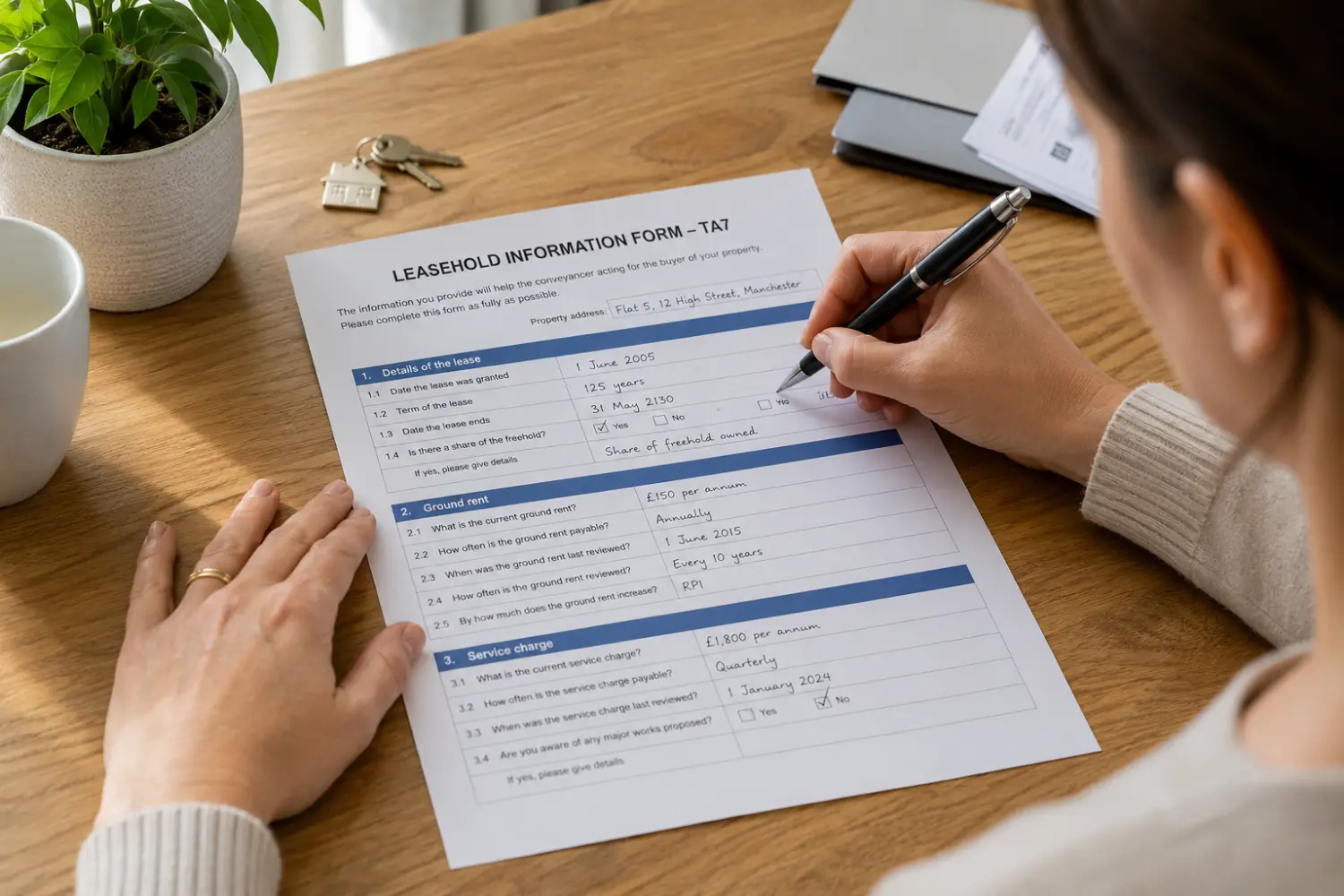
Not sure what counts as a notice or consent on your TA7 form?
These sections trip up a lot of sellers, especially when paperwork from years ago has gone missing. Speaking to your conveyancing solicitor before you submit the form means you can get in touch with our conveyancing team and check your answers before they’re sent to the buyer.
What is an LPE1 form, and do I need one too?
Alongside your TA7, your freeholder or managing agent will usually need to complete a separate LPE1 form, which answers many of the same questions from their side of the building.
Our guide on what is an LPE1 form explains what it covers and why buyers ask for one before exchanging contracts.
Need Help With Your Leasehold Property Sale?
Our experienced conveyancing solicitors can guide you through the TA7 leasehold information form and manage your leasehold property transaction from start to finish.
What happens if you get the TA7 form wrong?
Buyers and their solicitors rely on your TA7 leasehold information form to decide whether to proceed with the purchase, and at what price.
If you leave out information you should reasonably have known about, or give a misleading answer, your buyer may be able to claim against you after completion if they can show they’ve suffered a loss as a result.
The safest approach is to complete the form as fully as possible, tell your solicitor if anything changes before completion, and never guess an answer you’re not sure about.
Tips for completing your TA7 leasehold information form
A few habits make completing your TA7 form much easier, and reduce the chance of delays once a buyer is found:
- Request your lease, service charge accounts and any Section 20 notices early
- Contact your management company for up-to-date payment demands
- Say “not known” rather than guessing an answer
- Flag ongoing disputes to your conveyancing solicitor before you sign
- Update your answers straight away if anything changes before completion
Common questions about the TA7 leasehold information form
Do I need a TA7 form for a freehold house?
No. The TA7 is only required when you’re selling a leasehold property, such as a flat, maisonette, or a house held on a long lease. Freehold sales use the TA6 and TA10 forms instead.
What if my service charges have changed recently?
You’ll need to disclose this in the maintenance and service charges section of the TA7 form. The government’s guidance on leasehold service charges explains what a landlord can and can’t charge, though your solicitor can advise on your specific lease.
Our own guide to leasehold service charges covers what’s typically included.
Who fills in the ground rent details on the TA7 form?
You do, as the seller, based on your most recent payment demand. If you’re unsure whether you pay ground rent or a chief rent, our guide on chief rent and ground rent explains the difference.
Can I complete a TA7 form without my lease to hand?
It’s much harder. Request a copy from your management company or landlord as early as possible, ideally before you put your leasehold property on the market, so you’re not held up once a buyer is found.
How a conveyancing solicitor can help
A conveyancing solicitor will read through your TA7 form with you, chase your management company for missing paperwork, and make sure nothing is left blank that could hold up your sale.
If leasehold costs are putting you off selling altogether, it’s worth reading our guide on why people avoid leasehold properties first, since many of the concerns it raises are exactly what the TA7 form is designed to disclose fairly.
Our residential conveyancing solicitors handle leasehold and freehold sales across Manchester and the wider North West, with fixed fees and a dedicated point of contact throughout your sale.
Ready to sell your leasehold property with confidence?
Selling a leasehold flat or maisonette involves more paperwork than a straightforward freehold sale, but the right support makes it manageable. From your TA7 leasehold information form through to exchange and completion, our team keeps you informed at every stage.
Get in touch today, or use our online calculator for a fixed conveyancing quote in minutes.
-
What’s the difference between exchange of contracts and completion?

-
What you need to know about buying a property jointly

-
Why is my conveyancing taking so long? The honest answer

-
Can you use the same conveyancer as the seller?

-
Additional conveyancing fees you might not expect to pay
-
What is a TA13 form? Completion information and requisitions on title explained
-
What is a TA6 property information form?
-
What is a TA10 form?

-
What is checked during conveyancing? A complete guide

-
What salary do you need for a £300k house in the UK?