



What happens on exchange of contracts?
Exchange of contracts is the moment a property transaction becomes legally binding. Before exchange, either the buyer or the seller can walk away from the deal without penalty — which is why the weeks before it can feel uncertain. After exchange, neither party can withdraw without facing significant financial consequences.
For most buyers and sellers, exchange is the point at which genuine relief sets in. The completion date is confirmed, the price is locked, and both sides are committed. Understanding exactly what happens — and what you need to have in place before your solicitor makes the call — means you can prepare properly rather than scramble at the last minute. This guide walks through the conveyancing process UK step by step, from the conditions that must be met before exchange right through to what you should be doing in the days and weeks that follow.
Where exchange sits in the conveyancing process
Exchange of contracts does not happen at the start of a property transaction — it is the culmination of weeks of legal work carried out on both sides. By the time your solicitor exchanges, a significant amount has already taken place.
| Stage | Typical timing | What happens |
|---|---|---|
| Offer accepted | Day 0 | Sale agreed in principle; both sides instruct solicitors |
| Solicitors instructed | Week 1–2 | Conveyancing begins; title checks and searches ordered |
| Searches returned | Week 3–6 | Local authority, drainage and environmental searches reviewed |
| Enquiries raised and answered | Week 4–10 | Buyer’s solicitor raises questions; seller’s solicitor responds |
| Mortgage offer issued | Week 4–8 | Formal mortgage offer received in writing from lender |
| Contracts signed | Week 8–12 | Both parties sign; not yet legally binding |
| Exchange of contracts | Week 8–12 | Solicitors exchange; sale becomes legally binding; deposit paid |
| Between exchange and completion | Days to weeks | Funds arranged; insurance in place; completion date confirmed |
| Completion | Agreed at exchange | Balance transferred; keys released; buyer moves in |
The table above reflects a typical residential purchase. Timings vary considerably depending on the length of the chain, the complexity of the title, the speed of searches, and how quickly all parties respond to enquiries. The conveyancing process can take as little as six weeks in simple, chain-free transactions, or as long as five to six months where multiple linked sales are involved.
What must be in place before exchange of contracts?
Your solicitor will not exchange contracts until a checklist of conditions has been satisfied. Some of these are legal requirements; others are practical safeguards to protect you from commitments you cannot honour.
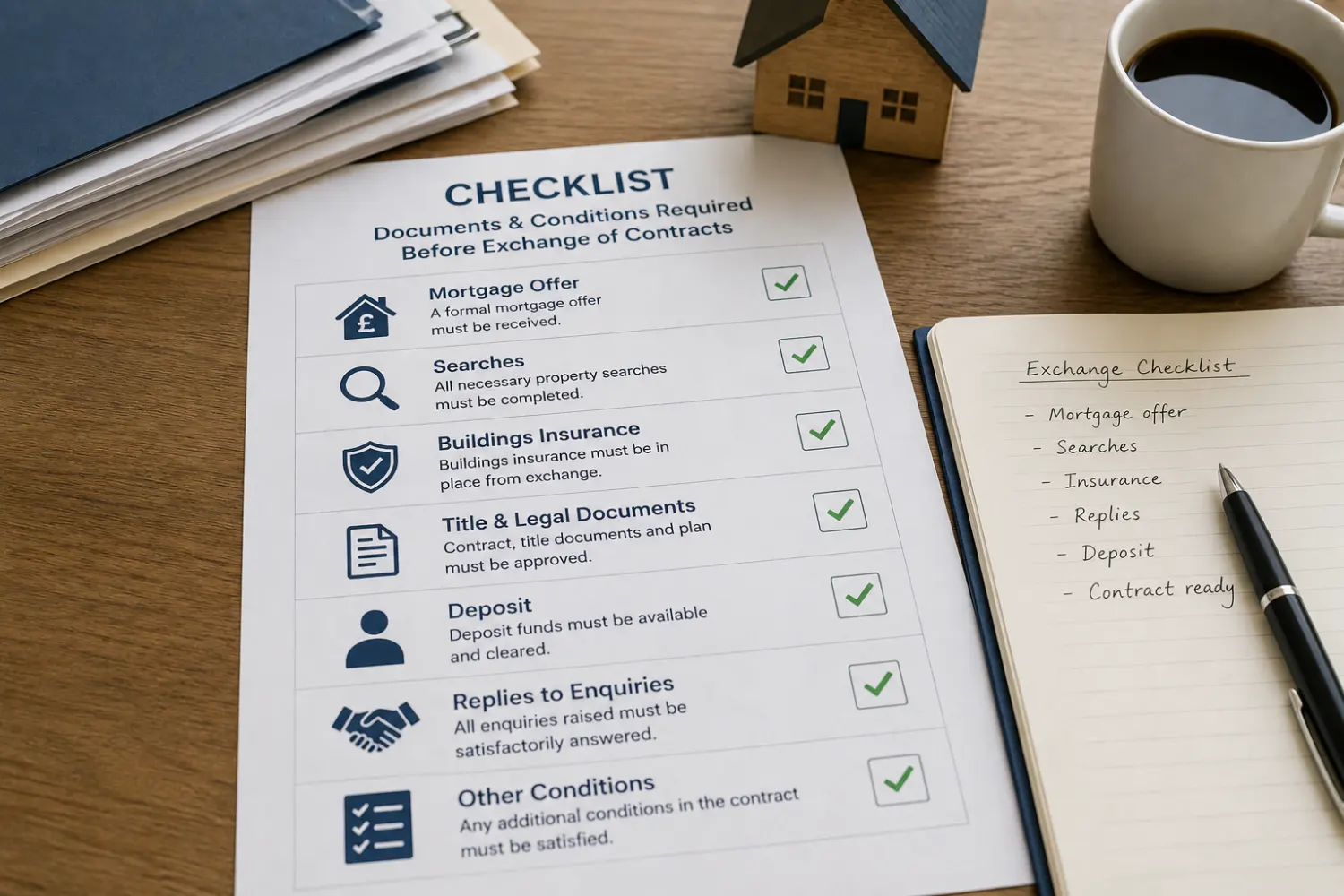
The conditions that must be met before exchange include:
- Formal mortgage offer — your lender must have issued a written mortgage offer, not just an agreement in principle. Your solicitor will review the offer conditions before exchange.
- Satisfactory searches — local authority, drainage and environmental searches must have been returned and reviewed. Any issues arising from searches need to have been addressed or accepted.
- Enquiries resolved — the buyer’s solicitor will have raised a series of formal questions about the property. All material enquiries must have been answered to the buyer’s satisfaction before exchange.
- Deposit funds available — the exchange deposit, typically 10% of the purchase price, must be held by your solicitor and ready to transfer. Some lenders allow a lower deposit by arrangement, but this must be agreed in advance.
- Buildings insurance arranged — from the moment of exchange, the buyer is legally responsible for the property. Buildings insurance must be in force from exchange, not from completion. If you are buying a leasehold flat, check whether the freeholder’s policy covers the building before arranging your own.
- Completion date agreed — the date of completion is written into the contract at exchange. Both parties must have agreed on this date before contracts are exchanged.
- Contract reviewed and signed — both buyer and seller sign their respective copies of the contract, but they are not legally committed until the exchange itself takes place.
What actually happens when solicitors exchange?
The exchange of contracts is almost always done by telephone rather than in person. Both solicitors read out the contracts to each other over a recorded call, confirm that the documents are identical, and then release their respective copies. The buyer’s solicitor sends the signed contract to the seller’s solicitor and transfers the deposit. The seller’s solicitor sends their signed contract in the other direction.
This simultaneous exchange — known as Formula B in Law Society practice — is the standard mechanism used in most residential chains. Once both solicitors confirm the exchange on the phone, the sale is legally binding. There is no ceremony, no handshake, and nothing for the buyer or seller to do on exchange day itself beyond waiting for the call from their solicitor confirming it has happened.
If you are part of a chain, your solicitor must co-ordinate with every other solicitor in the chain before any contracts are released. All parties must be ready to proceed simultaneously. A single delay — one buyer waiting on a revised mortgage offer, one seller waiting on replies to searches — can hold up the entire chain.
What happens between exchange and completion?
The period between exchange and completion is typically one to two weeks, though the gap can be much shorter or considerably longer depending on what has been agreed. In some transactions — particularly chain-free cash purchases — exchange and completion happen on the same day.
This period is not a quiet one for your solicitor. There is a significant amount of legal and financial activity taking place in the background:
For the buyer’s solicitor
- Raising a financial statement showing all funds required for completion and confirming the amount the lender will transfer
- Submitting a certificate of title to the mortgage lender and requesting the mortgage funds
- Preparing the transfer deed (TR1) for signature by the seller
- Conducting a pre-completion Land Registry search to check for any new charges registered since the original search
- Confirming stamp duty land tax payable — buyers can use the Versus Law
The stamp duty calculation can be checked in advance using the Versus Law stamp duty calculator to understand what will be owed on completion day.
For the buyer
- Ensuring all funds are in a position to be transferred on completion day — mortgage funds, deposit balance, and any additional costs
- Carrying out a pre-completion inspection of the property to confirm its condition and that agreed fixtures and fittings remain in place
- Confirming contents insurance is in force from completion
- Arranging a removal company for moving day, now that the completion date is fixed
- Notifying relevant parties of the change of address
Buying jointly? Get the ownership structure right before exchange.
Exchange is also the moment the ownership structure of the property becomes fixed. If you are buying with someone else — especially as an unmarried couple or where contributions to the purchase price differ — it is essential to have agreed how the property will be held before contracts are exchanged. Our guide to joint tenancy versus tenants in common explains the critical differences and why getting this wrong can be expensive to unpick later.
Can you pull out after exchange of contracts?
Technically, yes. But the consequences are severe enough that withdrawal after exchange is extremely rare.
If the buyer withdraws after exchange, they will lose their exchange deposit. Depending on the terms of the contract, the seller may also be entitled to pursue the buyer for any additional losses suffered — for example, a fall in the property’s value or costs incurred as a result of the collapse.
If the seller withdraws after exchange, they must return the buyer’s deposit in full. The buyer may also be able to seek a court order for specific performance — requiring the seller to complete the sale — or claim damages for losses arising from the breach.
The practical consequence of this is that both sides are, for all meaningful purposes, committed from the point of exchange. In well over 99% of cases, properties that exchange do complete. This is why solicitors and estate agents treat exchange as the moment to celebrate — it is as close to certainty as property transactions get before the keys change hands.

Need Help With Your Property Purchase?
Our experienced conveyancing solicitors can guide you through exchange of contracts, completion and every stage of your property transaction.
What can go wrong between exchange and completion?
Problems arising after exchange are unusual but not impossible. The most common issues include:
- Mortgage lender withdrawing the offer — rare, but can happen if the buyer’s financial circumstances change materially before completion. This can cause the entire transaction to collapse.
- Seller failing to vacate — if the seller has not left the property by the agreed completion time, the buyer may be unable to move in on the day. The contract will specify a time by which the property must be vacated, and failure to comply may result in financial penalties.
- Damage to the property between exchange and completion — this is why buildings insurance from the date of exchange matters. If the property is damaged before completion, the buyer is responsible for it even though they do not yet hold the keys.
- Chain collapse — if another transaction in the chain falls apart after your own exchange, there may be no way to complete on the agreed date. This situation is complex and solicitors will need to advise on the options available.
None of these scenarios is common, and all are reasons why having an experienced solicitor managing your transaction makes a genuine difference — not just in processing paperwork, but in knowing how to respond when something unexpected occurs.
Buying a leasehold property? Exchange works slightly differently
For leasehold property purchases, there are additional steps in the conveyancing process before exchange can take place. The seller’s solicitor must obtain a leasehold management pack from the freeholder or managing agent, which contains information about service charges, ground rent, major works planned, and the terms of the lease.
This pack can take several weeks to arrive and must be reviewed carefully before exchange. Issues with the lease — a short remaining term, onerous ground rent escalation clauses, or significant planned service charge expenditure — can materially affect whether the purchase proceeds and on what terms.
The UK Government guidance on leasehold property provides a useful overview of leaseholder rights and obligations for buyers who are unfamiliar with how leasehold ownership works in practice.
Preparing for exchange: a practical checklist
In the final weeks before your exchange date, there are several things worth doing to make sure you are ready:
- Chase your solicitor for an update on where enquiries stand — are there any outstanding questions that could delay exchange?
- Confirm your deposit funds are accessible and can be transferred quickly — do not leave this until the day before
- Arrange and confirm buildings insurance that starts from exchange, not completion
- If buying jointly, confirm with your solicitor how the property will be held and whether a declaration of trust is needed
- Agree and confirm the completion date with your solicitor, estate agent, and any removal company you have provisionally booked
- Re-read the contract and flag anything you are unclear about before you sign it
Ready to move forward with your purchase?
Exchange of contracts is a critical milestone — and getting there smoothly depends on having a conveyancing solicitor who keeps the process moving, communicates clearly, and responds quickly when questions arise. At Versus Law, our conveyancing team handles residential purchases and sales across England and Wales with fixed fees and proactive case management.
Whether you are approaching exchange, still waiting on searches, or just starting out with a new offer, we can help you understand where you are and what happens next.
-
What’s the difference between exchange of contracts and completion?

-
What you need to know about buying a property jointly

-
Why is my conveyancing taking so long? The honest answer

-
Can you use the same conveyancer as the seller?

-
Additional conveyancing fees you might not expect to pay
-
What is a TA13 form? Completion information and requisitions on title explained

-
What is a TA7 leasehold information form?

-
What is a TA6 property information form?
-
What is a TA10 form?

-
What is checked during conveyancing? A complete guide