



Additional conveyancing fees you might not expect to pay
When you’re budgeting for moving home, most people focus on the price of the property, stamp duty, and their solicitor’s headline conveyancing quote. But additional conveyancing fees can catch buyers and sellers off guard if nobody explains them upfront.
A fixed-fee quote covers the standard legal work involved in a straightforward sale or purchase. If your solicitor knows from the outset that your transaction involves something more complex, such as a leasehold property, mortgage, gifted deposit, or new build, the relevant additional work may already be shown in your quote. If an issue only becomes apparent later, an additional fee may need to be added.
Understanding these potential hidden conveyancing costs before you instruct a solicitor can help you budget properly and avoid surprises near completion.
This guide explains where additional conveyancing fees typically come from, the circumstances in which they may apply, what conveyancing disbursements actually cover, and how to keep your final bill as close as possible to the quote you received.
What counts as an additional conveyancing fee?
An additional conveyancing fee is a charge for legal or administrative work that falls outside the work covered by the standard conveyancing fee. Depending on what is known when you request your quote, it may be included from the outset or added later if the additional work only becomes necessary as the transaction progresses.
Common circumstances that can require extra work include:
- Buying or selling a leasehold, share of freehold, or managed freehold property
- Using a gifted deposit from family or friends
- Buying with a mortgage
- Buying a new-build property
- Dealing with multiple registered titles
- Dealing with a restriction, caution, or defect on the title
- Corresponding with third-party lawyers, such as in a divorce or probate matter
- Arranging bridging finance or dealing with an auction purchase
These situations usually involve additional checks, documents, correspondence, reporting, or registration work that would not be required on a straightforward transaction.
For a full breakdown of the charges that may apply, see our additional legal fees and charges.
Common additional fees during a standard purchase or sale
Even a relatively straightforward transaction can require extra work depending on the property, the source of the purchase funds, and the way the property is financed.
Some of the additional services that may be required include:
- Additional bank transfers: where extra payments need to be made, such as dividing sale proceeds between several owners or arranging an additional same-day transfer.
- Additional enquiries arising from a survey: where the purchaser requires advice on further enquiries raised as a result of their survey report.
- Gifted deposit administration: covering the additional source-of-funds work associated with a gifted deposit and reporting to the mortgage lender where necessary.
- Mortgage work: where additional legal work is required for both the client and lender when a mortgage is secured against the property.
- Multiple title reviews: where the property involves more than one registered title, such as a separate garage, stable, parcel of land, or another title affecting the property.
- Indemnity policy administration: for obtaining quotations, reviewing the appropriate policy, and arranging cover where an indemnity policy is required.
- Additional identity checks: where the usual digital verification process cannot be used and further identity or anti-money laundering checks are required.
Not every transaction will attract these fees. The exact charges depend on the circumstances of your sale or purchase, so it is important to disclose anything unusual when requesting your quote.
You can view our current additional conveyancing fees for the latest pricing.
Bank transfers and third-party correspondence fees
Some transactions require extra correspondence outside the usual buyer-and-seller conveyancing process.
This may include corresponding with a third-party lawyer or complying with a court order, such as during a divorce or probate matter.
Additional work may also be required where Versus Law is not acting for the mortgage lender and must liaise with the lender’s separate solicitors and comply with their requirements.
These charges reflect the extra legal and administrative work involved beyond the standard correspondence already covered by the conveyancing transaction.
Extra costs for leasehold and complex leasehold properties
Leasehold transactions usually involve more legal work than a straightforward freehold sale or purchase because there are additional documents to review and third parties such as landlords, freeholders, and managing agents may need to be involved.
Versus Law may charge an additional legal fee for leasehold, share of freehold, or freehold properties with a managing agent. If you tell us about the property type when requesting your quote, any applicable additional work can be identified from the outset.
Other work can sometimes be required as the transaction progresses, including:
- Liaising with an additional managing agent
- Reviewing an additional lease
- Drafting a Deed of Covenant
- Drafting a Deed of Variation
- Reviewing or negotiating a lease extension
There may also be fees payable directly to a landlord, freeholder, or managing agent. These are separate from Versus Law’s legal fee and will depend on the individual property and management arrangements.
A share of freehold or a freehold property with a managing agent can therefore still involve additional conveyancing work, even though there may not be a conventional residential lease to review.
For the latest charges relating to leasehold and managed properties, see our additional fees page.
Additional fees for auction, bridging finance, and new-build purchases
Certain types of property purchase require considerably more work than a standard transaction and can therefore attract higher additional conveyancing fees.
These can include:
- Auction purchases: where additional work is required to review auction documentation and complete within shorter timescales.
- Bridging finance: where additional legal work is required in connection with short-term lending and lender requirements.
- New-build purchases: where extra work may include reviewing estate and plot plans, utility connections, accessways, planning permissions, road development agreements, indemnity requirements, and developer documentation.
- Buy-to-let purchases: where additional checks may be required depending on how the property is being purchased and whether vacant possession is required.
These are particularly important costs to identify before committing to an auction property, bridging loan, or new-build reservation, as the additional legal work forms part of the overall cost of completing the transaction.
A new-build property can look straightforward because nobody has lived in it before, but from a conveyancing perspective there is often considerably more documentation for your solicitor to review.
Full details of the charges that may apply are available on our additional conveyancing fees page.
Other circumstances that can increase your conveyancing fees
Some additional charges only apply in particular situations but can still make a significant difference to the legal work required.
Examples include:
- High-rise properties: where additional work may be required to deal with requirements under the Building Safety Act.
- Overseas or non-UK resident clients: where additional identity, source-of-funds, notarisation, or legalisation work may be required.
- Restrictions or cautions on the title: where extra legal work is needed to identify and resolve issues affecting the registered title.
- Concessionary purchases: where a property is sold to a related party at a discount and additional checks, lender reporting, or insolvency considerations arise.
- Help to Buy ISA or Lifetime ISA administration: where additional administration is required in connection with eligibility and obtaining the relevant government bonus.
Again, these charges only apply where the relevant circumstances exist. Giving your conveyancer full details as early as possible helps them identify which fees are likely to apply before significant work begins.
You can check our full list of additional fees for current pricing and further information.
Conveyancing disbursements you’ll need to budget for
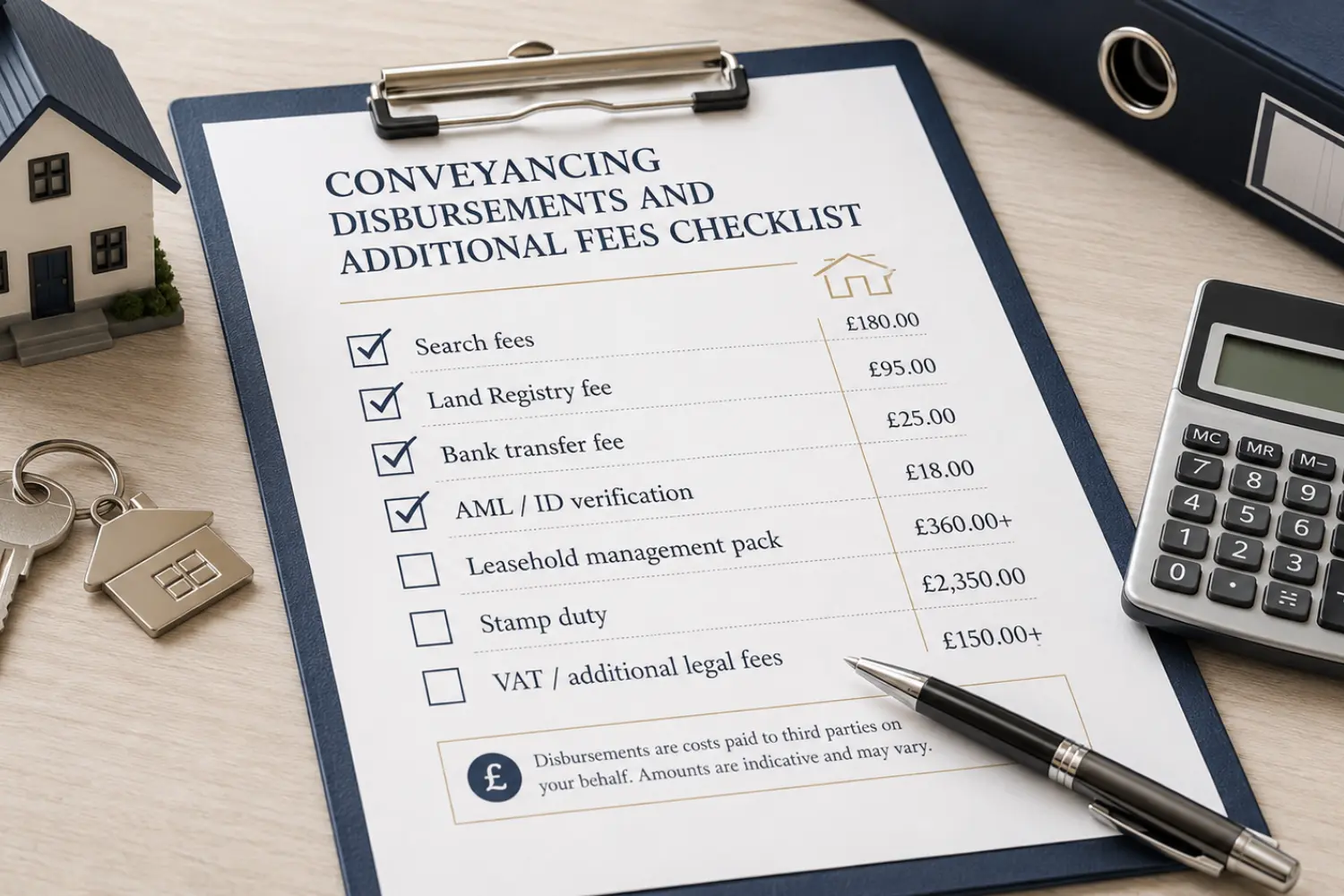
Conveyancing disbursements are different from your solicitor’s legal fees.
A legal or administrative fee pays your conveyancer for work carried out on the transaction. A disbursement is generally an amount your solicitor pays to a third party on your behalf as part of completing the transaction.
Common examples can include:
- Local authority searches
- Environmental searches
- Drainage and water searches
- HM Land Registry registration fees
- Fees charged by landlords, freeholders, or managing agents where applicable
- The premium payable for an indemnity insurance policy where one is required
This distinction matters. For example, Versus Law may charge an administration fee for arranging an indemnity policy, while the actual insurance premium is a separate cost payable for the policy itself.
Stamp Duty Land Tax is another significant cost that many buyers need to budget for. It is a tax payable to HMRC rather than a legal fee charged by your conveyancer.
If you’re buying a property, you can check likely Stamp Duty Land Tax costs before committing to the purchase.
Because disbursements and taxes depend on the individual property and transaction, ask for a clear breakdown of your legal fees, additional fees, disbursements, and taxes when reviewing your quote.
Not sure which additional fees apply to your move?
Every transaction is different, and the best way to find out which additional conveyancing fees might apply to yours is to tell us about your circumstances when requesting your quote.
Our Manchester team can explain which charges are relevant and which are not. Get in touch with our conveyancing team and we’ll explain what’s included in your quote.
How to avoid unexpected hidden conveyancing costs
What people sometimes describe as “hidden conveyancing costs” are often additional charges triggered by circumstances that were not apparent when the first quote was prepared.
A little preparation can make it much easier to identify them upfront.
- Ask for a written quote that separates legal fees, additional charges, and disbursements.
- Tell your solicitor upfront if the property is leasehold, share of freehold, managed freehold, or a new build.
- Confirm whether you are buying with a mortgage or using bridging finance.
- Disclose a gifted deposit as early as possible.
- Tell your solicitor if you are buying at auction or working towards an unusually short completion deadline.
- Mention if the property includes multiple registered titles, such as a separate garage or parcel of land.
- Query anything described as an estimate rather than a fixed cost.
- Ask whether any additional fees shown in the firm’s published fee schedule are likely to apply to your circumstances.
- Ask what happens to fees and disbursements if the transaction falls through.
The government’s guidance on Stamp Duty Land Tax is also a useful starting point for understanding how this separate tax may affect your moving budget.

Why choose Versus Law for transparent, fixed-fee conveyancing
At Versus Law, we quote for residential conveyancing on a fixed-fee basis, so you know what the standard legal work covered by your quote will cost.
Where additional work applies, such as dealing with a leasehold property, mortgage, gifted deposit, multiple titles, or new-build purchase, we aim to identify the relevant charges as early as possible.
You can also see our published additional legal fees and charges online, making it easier to understand which additional services may apply to your transaction and check the latest pricing.
Our Manchester-based team is CQS accredited and has handled more than 10,000 property exchanges, giving you a dedicated point of contact who knows your file rather than a call centre, with a clear breakdown of your legal fees and conveyancing costs from the outset.
Whether you’re buying a first flat in the city centre, selling a family home in Chorlton, or dealing with a more complex leasehold transaction, our proactive approach means we chase third parties before delays happen, not after, and keep you updated by phone, email, or WhatsApp throughout.
Ready to get a clear, fixed-fee conveyancing quote?
Understanding additional conveyancing fees before you start is one of the best ways to keep your house move on budget.
Our team will talk you through your quote in plain English, explain which legal fees and conveyancing disbursements apply to your case, and identify any additional work we know will be required.
-
What happens on exchange of contracts?

-
What’s the difference between exchange of contracts and completion?

-
What you need to know about buying a property jointly

-
Why is my conveyancing taking so long? The honest answer

-
Can you use the same conveyancer as the seller?

-
What is a TA13 form? Completion information and requisitions on title explained

-
What is a TA7 leasehold information form?

-
What is a TA6 property information form?

-
What is a TA10 form?

-
What is checked during conveyancing? A complete guide