



What are service charges and what do they cover?
Service charges are one of the most significant ongoing costs for leasehold property owners in the UK — and one of the least well understood before purchase. At their core, service charges leasehold arrangements require flat owners and long leaseholders to contribute to the costs of maintaining and managing the building they live in. But what those charges actually cover, how they are calculated, and what your rights are when they seem unreasonable are questions that trip up buyers and existing owners alike.
This guide explains what service charges are, what do service charges cover in practice, how the figures are set, and what protections the law gives you as a leaseholder. Understanding leasehold property costs at this level of detail matters particularly before you buy — because service charges that look manageable today can change significantly, and buyers who do not ask the right questions before exchange can face surprises that affect both their budget and their resale value.
What are service charges in leasehold properties?
A service charge is a payment made by a leaseholder to the landlord, freeholder, or managing agent to cover the costs of services provided to the building and its shared areas. The legal basis for the charge comes from the lease itself — the landlord can only recover costs through a service charge if the lease expressly provides for it. If the lease does not include a particular cost, the landlord cannot charge for it regardless of what work was carried out.
Service charges are distinct from ground rent, which is a payment made simply for the right to occupy the land under the property and does not relate to services provided. For most new leases granted after 30 June 2022, ground rent is capped at a peppercorn (effectively zero), but service charges remain a live and variable leasehold property cost throughout the entire term of the lease.
The amount payable as service charges leasehold owners face is not fixed in advance indefinitely. In most residential leases, service charges are variable — meaning they change year on year depending on what has actually been spent on the building. The lease will specify how each leaseholder’s share is calculated: it may be expressed as a percentage of total costs, as a proportion based on floor area, or simply as a “fair and reasonable proportion.” Whatever the formula, each leaseholder pays a defined share of the building’s total outgoings.
What do service charges cover?
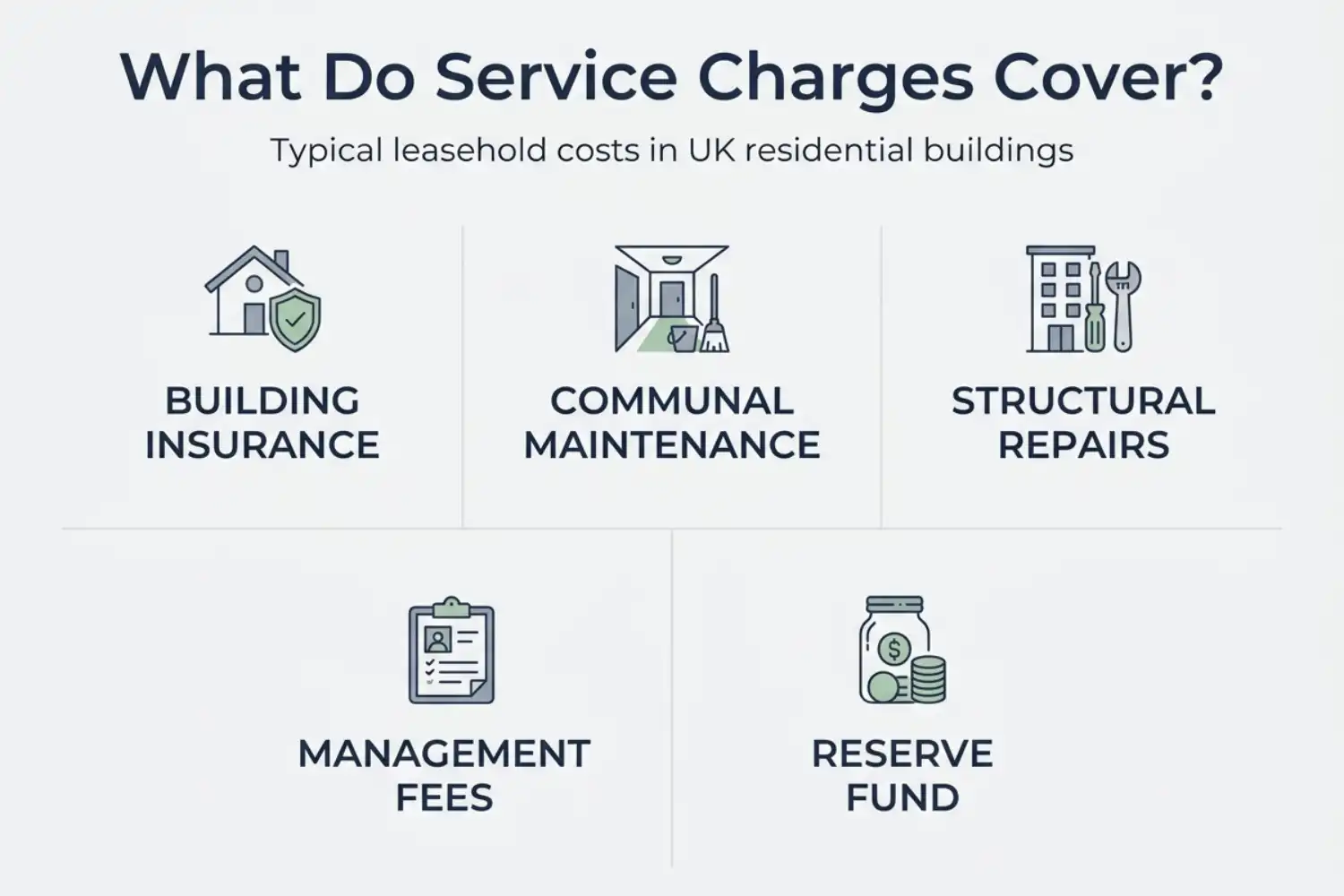
The specific items covered by a service charge depend on the lease, the type of property, and what the freeholder or managing agent has contracted to provide. However, the categories that commonly appear across residential leasehold buildings in the UK include the following.
Building insurance
Your landlord is usually responsible for insuring the fabric of the building — the structure, roof, and common parts — and the cost of that insurance premium is recovered through the service charges leasehold arrangement. This covers the building itself; it does not cover your personal possessions or contents, for which you need separate cover. Before purchasing a leasehold property, it is worth checking both the level of building insurance in place and how the premium has changed over recent years, as significant increases will be reflected in your service charge.
Maintenance and repair of communal areas
The day-to-day upkeep of everything outside your front door but within the building is typically covered by the service charge. This is one of the more predictable categories of leasehold property cost and includes:
- Cleaning of hallways, stairwells, lobbies, and communal corridors
- Lighting of shared spaces and external areas
- Lift maintenance, servicing, and repair
- Maintenance of entry systems, intercoms, and communal doors
- Window cleaning on communal and external glazing
- Upkeep of any shared garden areas, car parks, or external paths
Repairs and maintenance of the building structure
The exterior fabric of the building — the roof, foundations, guttering, communal drains, and external walls — generally falls within what service charges cover for the freeholder to maintain. In an FRI (Full Repairing and Insuring) arrangement, these costs are passed directly to leaseholders through the service charge. The extent to which structural repairs are the landlord’s responsibility rather than the tenant’s depends on how the lease is drafted.
Management fees
Where a professional managing agent is appointed to run the building — collecting service charges, arranging maintenance contracts, dealing with insurance, and managing the building’s day-to-day affairs — their fees are recovered through the service charges leasehold residents pay. Management fees vary considerably depending on the size and complexity of the building, and they are a legitimate cost that can be included in the service charge provided they are reasonable. Leaseholders have the right to challenge management fees they consider disproportionate.
Reserve fund and sinking fund
Most well-managed buildings include a contribution to a reserve fund — sometimes called a sinking fund — within the annual service charge. This is money set aside against the cost of future major works, such as replacing the roof, refurbishing the communal areas, or overhauling the lifts. The purpose is to spread the cost of large-scale repairs across all leaseholders and across time, so that no single year’s service charge is disproportionately high.
Understanding what do service charges cover in this context is particularly important at the point of purchase. A building with a healthy sinking fund is likely to have more predictable future costs than one where no reserve has been built up — because the latter will either defer necessary maintenance (creating problems later) or hit leaseholders with a large, unplanned bill when the work can no longer be put off.
How service charges leasehold owners pay are calculated
Service charges in residential leasehold properties typically operate on an advance estimate basis. At the beginning of each service charge year, the landlord or managing agent issues an estimated budget for the year ahead. Leaseholders pay instalments based on this estimate — usually monthly, quarterly, or annually — throughout the year.
At the end of the year, the actual expenditure is reconciled against the estimate. If the building spent more than anticipated, leaseholders are asked to make up the shortfall. If it spent less, the surplus is either credited to the following year’s account or, in some cases, refunded. This means your service charge in any given year is not entirely predictable in advance — it is adjusted once actual costs are known.
The share of the total cost you pay as an individual leaseholder is set out in your lease. Common methods include a percentage allocation to each unit (which may or may not reflect floor area), an equal split between all flats, or a proportionate split based on the size or type of each unit. Some leases specify that each leaseholder pays a “fair and just proportion,” which gives less certainty but allows for flexibility where properties are substantially different in size.
What service charges cover can also vary between buildings in the same development. In large mixed-use schemes, the service charge structure can be complex, with different buildings or phases contributing to different service charge pools depending on which facilities they have access to.
Major works and Section 20 consultation
One of the most significant financial events in any leaseholder’s experience is a major works programme — a large-scale project affecting the building, such as roof replacement, external redecoration, or lift overhaul. These projects can cost tens or hundreds of thousands of pounds in total, with each leaseholder’s share potentially running into thousands.
The law provides important protections at this point. Under Section 20 of the Landlord and Tenant Act 1985, a landlord who proposes to carry out works that will cost any individual leaseholder more than £250, or to enter into a long-term maintenance contract that will cost any leaseholder more than £100 per year, is required to carry out a formal consultation process before committing to that expenditure. This Section 20 process involves notifying leaseholders of the proposed works, inviting them to nominate contractors for consideration, and giving them the opportunity to comment on the estimates obtained.
If the landlord does not comply with the Section 20 consultation requirements, their ability to recover costs from leaseholders is capped at £250 per leaseholder for the works in question. This is a meaningful protection — it means that skipping or shortcutting the consultation process has a direct financial consequence for the landlord. As a leaseholder facing major works, knowing whether the Section 20 process has been properly followed is one of the most important things to check before agreeing to pay.
Not sure what service charges really cover?
Service charges can include insurance, maintenance, management fees and future repair costs — and they can change over time. Get expert advice before committing to a leasehold property.
Your rights as a leaseholder in relation to service charges
The right to information
Leaseholders have a statutory right to request a written summary of the costs incurred during the previous accounting year, showing how the service charge has been calculated and what the funds were spent on. You can also request access to the supporting invoices, receipts, and contracts. The landlord must comply with this request within a reasonable time. Understanding what do service charges cover in your specific building — as opposed to in general — requires this level of transparency, and you are entitled to it.
The right to challenge
Service charges leasehold owners pay are only recoverable by the landlord if they are reasonable. If you believe a charge is unreasonable — whether because the work was unnecessary, the cost was excessive, or the service was not actually provided — you have the right to apply to the First-tier Tribunal (Property Chamber) to have the charge assessed. The Tribunal can determine whether the costs are reasonable and, if not, reduce them. You cannot apply to the Tribunal in respect of a fixed service charge (one whose amount is set in the lease itself), but variable charges — which are the norm in residential leasehold — are challengeable.
Challenging a service charge is a serious step that should be considered carefully, ideally with legal advice. However, the right to do so is an important protection given the scale of leasehold property costs and the potential for mismanagement or overcharging. The Leasehold Advisory Service (LEASE) is a free government-funded service that provides guidance to leaseholders navigating disputes with their landlord or managing agent.
Protection of service charge funds
Service charge contributions must be held on trust by the landlord, in a separate account designated for that purpose. This means that if the landlord or managing agent becomes insolvent, the service charge funds are protected and cannot be claimed by their creditors. It is a basic but important protection that ensures the money you have paid for building maintenance cannot be lost in the event of a freeholder’s financial failure.
What do service charges cover when you are buying a leasehold property?
For buyers of leasehold properties, service charges leasehold arrangements represent a recurring cost that needs to be factored into affordability from the outset. The conveyancing process is the point at which you should gather the detailed information needed to understand what those charges look like — both historically and going forward.
During the purchase process, your solicitor will request the management information pack for the property. This includes three years of service charge accounts showing what has been spent and how the charges have been apportioned, any outstanding service charge balances the seller may owe, the current year’s estimated budget, and details of any planned major works. Reviewing this information carefully gives you a realistic picture of your likely leasehold property costs in the coming years and allows you to identify any red flags — such as an underfunded sinking fund, an upcoming major works programme, or a pattern of rapidly rising annual charges. Understanding the leasehold financial structure, including the LPE1 form that formalises this information transfer between seller and buyer, is covered in detail in our guide to what the LPE1 form is and why it matters in leasehold transactions.
If you want to understand the full financial picture of buying a leasehold property — including how service charges affect the conveyancing fee calculation — our instant conveyancing cost calculator gives you a transparent breakdown of all costs involved in your specific purchase, including the additional leasehold fee.
Getting proper advice on service charges leasehold properties
Service charges are one of the most important financial considerations in any leasehold property purchase or ownership, and they are an area where independent legal advice makes a material difference. A conveyancing solicitor reviewing your purchase will examine the service charge history, identify any outstanding balances or planned works, and advise you on what the figures mean for your leasehold property costs in the years ahead. They will also flag any concerns about the management of the building that could affect your ability to sell or remortgage in the future. Our residential conveyancing team advises buyers, sellers, and existing leaseholders across England and Wales on all aspects of leasehold transactions, including service charge reviews and disputes. If you have a question about your service charges or are in the process of buying or selling a leasehold property, get in touch with our team for a straightforward, no-obligation conversation about your situation.
Need advice on leasehold service charges before you buy?
Service charges are one of the biggest ongoing costs of leasehold ownership, and they are not always predictable. Understanding what they cover, how they are calculated, and whether major works are planned is essential before you commit. Our solicitors review service charge accounts, explain the risks, and help you make an informed decision before exchange.
-
What’s the difference between exchange of contracts and completion?

-
What you need to know about buying a property jointly

-
Why is my conveyancing taking so long? The honest answer

-
Can you use the same conveyancer as the seller?

-
Additional conveyancing fees you might not expect to pay

-
What is a TA13 form? Completion information and requisitions on title explained

-
What is a TA7 leasehold information form?

-
What is a TA6 property information form?

-
What is a TA10 form?

-
What is checked during conveyancing? A complete guide